


 Asian Currencies Muted as Dollar Firms Ahead of Trump-Xi Summit
  RBI Uses $10 Billion Currency Swaps to Drain Excess Rupee Liquidity
  European Stocks Slip as Iran Tensions Offset Strong Eurozone Data
  China’s ‘Lipstick King’ Says AI Won’t Replace Livestream Hosts
  US Stock Futures Fall as Treasury Yields Surge Ahead of Trump-Xi Summit
  Asian Currencies Mixed as Dollar Holds Near Two-Month High
  South Korea, US Discuss Warship Building Cooperation
  US Stock Futures Rise as Meta Muse Fuels AI Rally
  Oil Prices Surge as U.S.-Iran Diplomacy Hopes Fade
  Gold Prices Rise as Oil Slump Eases Fed Rate Hike Fears
  U.S. 10-Year Treasury Yield Hits 2007 High as Fed Rate Hike Bets Rise
  Australia Unemployment Hits Five-Year High Despite Strong Jobs Growth
  Russian Envoy Dmitriev Heads to US for Ukraine Talks
  US Dollar Hits Two-Month High as Fed Rate Hike Bets Rise
  Gold Prices Rise as Oil Slide Eases Fed Rate Hike Fears
  Wall Street Falls as Treasury Yields Surge, Oil Rebounds on Iran Tensions
  US, China Extend Trade Truce to Jan. 10 Ahead of Trump-Xi Summit


 Add as a preferred source on Google


The position of the US dollar in the global league table of foreign exchange reserves held by other countries is closely watched. Every slight fall in its share is interpreted as confirmation of its imminent demise as the preferred global currency for financial transactions.
The recent drama surrounding negotiations about raising the limit on US federal government debt has only fuelled these predictions by “dollar doomsayers”, who believe repeated crises over the US government’s borrowing limit weakens the country’s perceived stability internationally.
But the real foundation of its dominance is global trade – and it would be very complicated to turn the tide of these many transactions away from the US dollar.
The international role of a global currency in financial markets is ultimately based on its use in non-financial transactions, especially as what’s called an “invoicing currency” in trade. This is the currency in which a company charges its customers.
Global network of supply and trade
Modern trade can involve many financial transactions. Today’s supply chains often see goods shipped across several borders, and that’s after they are produced using a combination of intermediate inputs, usually from different countries.
Suppliers may also only get paid after delivery, meaning they have to finance production beforehand. Obtaining this financing in the currency in which they invoice makes trade easier and more cost effective.
In fact, it would be very inconvenient for all participants in a value chain if the invoicing and financing of each element of the chain happened in a different currency. Similarly, if most trade is invoiced and financed in one currency (the US dollar at present), even banks and firms outside the US have an incentive to denominate and settle financial transactions in that currency.
This status quo becomes difficult to change because no individual organisation along the chain has an incentive to switch currencies if others aren’t doing the same.
This is why the US dollar is the most widely used currency in third-country transactions – those that don’t even involve the US. In such situations it’s called a vehicle currency. The euro is used mainly in the vicinity of Europe, whereas the US dollar is widely used in international trade among Asian countries. Researchers call this the dominant currency paradigm.
The convenience of using the US dollar, even outside its home country, is further buttressed by the openness and size of US financial markets. They make up 36% of the world’s total or five times more than the euro area’s markets. Most trade-related financial transactions involve the use of short-term credit, like using a credit card to buy something. As a result, the banking systems of many countries must then be at least partially based on the dollar so they can provide this short-term credit.
And so, these banks need to invest in the US financial markets to refinance themselves in dollars. They can then provide this to their clients as dollar-based short-term loans.
It’s fair to say, then, that the US dollar has not become the premier global currency only because of US efforts to foster its use internationally. It will also continue to dominate as long as private organisations engaged in international trade and finance find it the most convenient currency to use.
What could knock the US dollar off its perch?
Some governments such as that of China might try to offer alternatives to the US dollar, but they are unlikely to succeed.
Government-to-government transactions, for example for crude oil between China and Saudi Arabia, could be denominated in yuan. But then the Saudi government would have to find something to do with the Chinese currency it receives. Some could be used to pay for imports from China, but Saudi Arabia imports a lot less from China (about US$30 billion) than it exports (about US$49 billion) to the country.
The US$600 billion Public Investment Fund (PIF), Saudi Arabia’s sovereign wealth fund, could of course use the yuan to invest in China. But this is difficult on a large scale because Chinese currency remains only partially “convertible”. This means that the Chinese authorities still control many transactions in and out of China, so that the PIF might not be able to use its yuan funds as and when it needs them. Even without convertibility restrictions, few private investors, and even fewer western investment funds, would be keen to put a lot of money into China if they are at the mercy of the Communist party.
China is of course the country with the strongest political motives to challenge the hegemony of the US dollar. A natural first step would be for China to diversify its foreign exchange reserves away from the US by investing in other countries. But this is easier said than done.
There are few opportunities to invest hundreds or thousands of billions of dollars outside of the US. Figures from the Bank of International Settlements show that the euro area bond market – a place for investors to finance loans to Euro area companies and governments – is worth less than one third of that of the US.
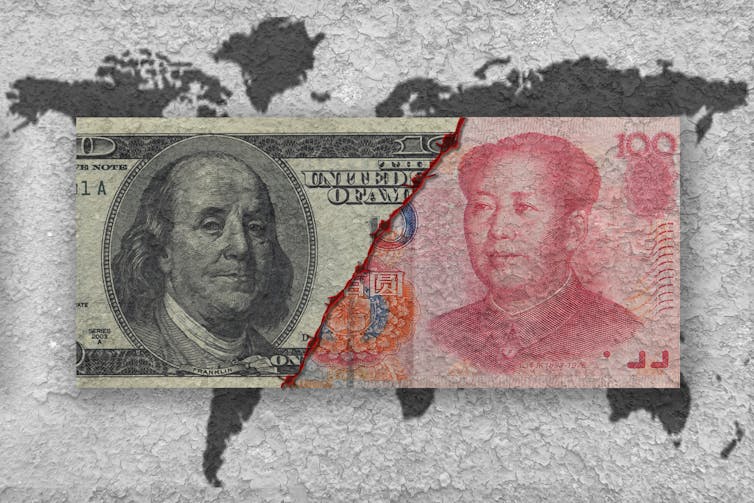
NothingIsEverything/Shutterstock
Also, in any big crisis, other major OECD economies like Europe and Japan are more likely to side with the US than China – making such a decision is even easier when they are using US dollars for trade. It was said that states accounting for one half of the global population refused to condemn Russia’s invasion of Ukraine, but this half does not account for a large share of global financial markets.
Similarly, it shouldn’t come as a surprise that democracies dominate the world financially. Companies and financial markets require trust and a well-established rule of law. Non-democratic regimes have no basis for establishing the rule of law and every investor is ultimately subject to the whims of the ruler.
When it comes to global trade, currency use is underpinned by a self-reinforcing network of transactions. Because of this, and the size of the US financial market, the dollar’s dominant position remains something for the US to lose rather for others to gain.







