In the UK, legal cases resolving alleged neighbour nuisances are ten-a-penny. Some – about overhanging trees or leylandii hedges that block out the sun – reach the local press. Few, however, have ever taken up the column inches devoted to Fearn v Tate.
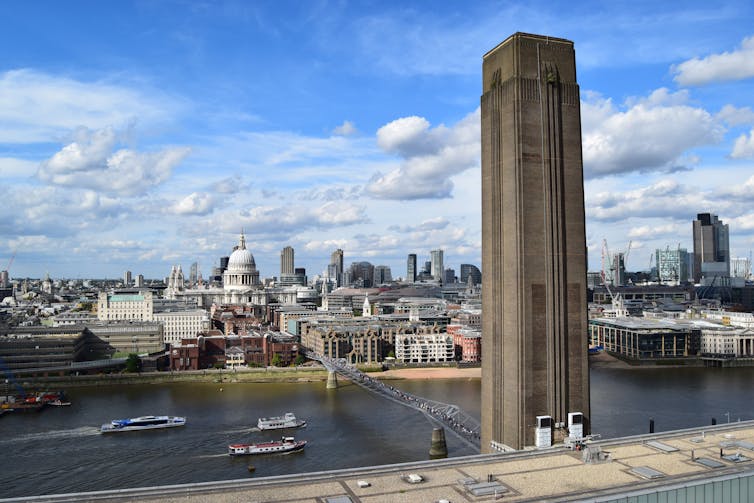
After a six-year legal battle, the UK supreme court has now ruled in favour of the five neighbouring residents who sued London’s Tate Modern, for infringing on their privacy with its viewing gallery that looks directly into their homes.
The trustees of the Tate now face the possibility of closing or screening off the viewing gallery. This is despite the fact that, in the same ruling, the supreme court deems it to be a perfectly “reasonable use” of the land, and that allowing visitors 360-degree views of the capital is of “public benefit”.
Developers are increasingly capitalising on the value of a view. Matthew Waring | Unsplash, CC BY-NC-SA
Breach of privacy claim
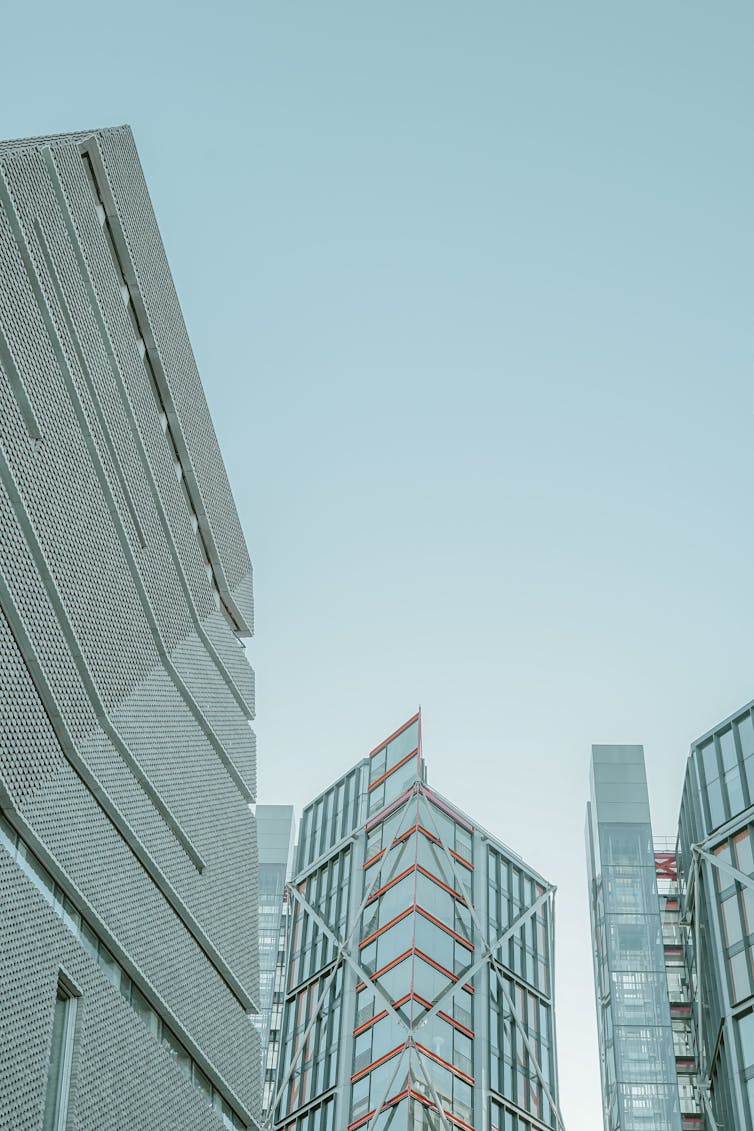
In 2017, five residents of the neighbouring Neo-Bankside development sued the Tate for invasion of privacy. Marketed as a “world-class” development, Neo-Bankside features floor-to-ceiling windows, designed to maximise light and take advantage of the views towards the Thames. The gallery’s Blavatnik extension, meanwhile, included an observatory deck. The residents said they were being subjected to close and oppressive scrutiny by museum goers armed with phones, cameras, and sometimes, binoculars.
The Fearne v Tate case could lead to further privatisation of London’s skies. Toa Heftiba | Unsplash, CC BY-NC-SA
Previous cases had established that you could sue for invasion of the airspace near to your property on the basis of trespass and nuisance law. Planning law similarly regards overlooking and loss of privacy as the basis for refusal of planning permission.
In his 2019 ruling, however, High Court Justice Anthony Mann pointed out that the Tate had been given planning permission for the viewing platform before Neo-Bankside was completed. In other words, the residents would have been aware of it before they moved in. He recommended they install net curtains.
This ruling implied that wealthy residents colonising urban skies need to recognise that they are not just in the city, but of it. It did not necessarily set a precedent. But it did suggest that the property rights enjoyed by the owners of glass-fronted flats do not necessarily extend to “lower strata” air rights, or the right to exclude others from viewing in.
Mann has now been overruled, the law once again aligning with the rich and powerful. The supreme court’s judgement confirms that being overlooked by a spectator gallery in fact does constitute a form of visual intrusion. And it rejects Mann’s judgement that the owners of the flats bore some responsibility for mitigating the nuisance themselves.
In theory, this could lead to a series of private nuisance lawsuits. Those living in high-rise properties could now claim they need to be protected from the nuisance of people looking in, and use this as a means to screen off existing development. Equally, planning officers might be minded to put more weight on overlooking as a material consideration.
Currently, drone flights at a “reasonable height” enjoy a statutory defence against claims of nuisance and trespass, under the terms of the 1982 Civil Aviation Act. But if concerns about overlooking are extended to the disembodied gaze of the unmanned drone camera, we might easily imagine a future city characterised by no-fly zones around the towers of the super-rich.
Gentrification of the skies
In the 1950s and 1960s, tower blocks were reserved for social housing tenants. Such “streets in the sky” were subsequently vilified as sites of social malaise.
By contrast, today’s high-rises are built for rich investors. Social housing, if at all present, is restricted to the lower levels, sometimes behind what has become known as a “poor door”.
Spectacular views are the big draw. Developers carefully price each flat according to height, size and aspect. This “luxification” of the skies is, perversely, accompanying the emergence of shrinking homes for the working poor, often literally overshadowed by these prestigious towers.
The Fearn v Tate judgement has confirmed that inner-city residents must expect to live cheek by jowl with their neighbours, while suggesting that there are different types of overlooking. Inviting people to look out, and photograph, from a property’s observation deck is qualitatively different than one property simply overlooking another.
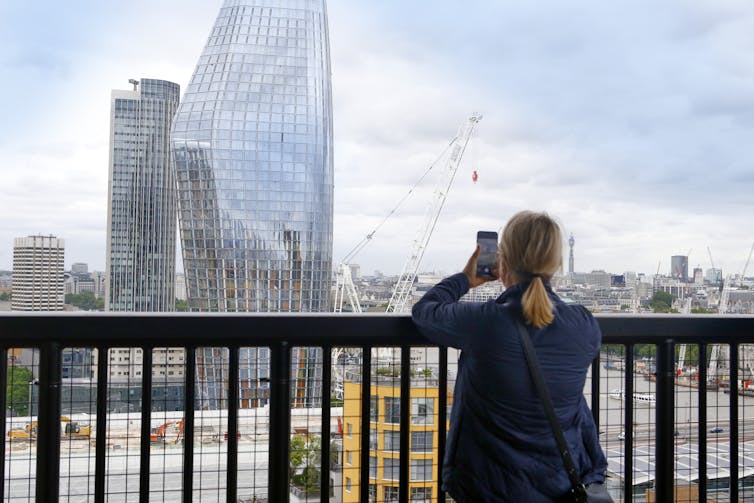
The law now appears to recognise different types of overlooking. Lara Ra
The supreme court judgement references an obscure case from 1341 where a London fishmonger had to remove a tower on his property because neighbours felt it constituted a nuisance. It argues that the intensity of interference is now magnified by the fact that people have smartphones with cameras.
Some have concluded the ruling is not simply about being overlooked but the invasion of privacy associated with photographs being shared on social media. However, given any neighbour could take photos of others’ property, should the precautionary principle now reign?
This could lead to those who can afford to take private action invoking visual intrusion to prevent others from even having the possibility of taking photos. It could lead to further privatisation of air space, of particular concern in cities like London where the urban commons are increasingly privatised.
A city where “air people” are able to escape surveillance while “street people” have to live with the constant scrutiny enacted by drones, CCTV and facial recognition systems may sound dystopian. Given the rampant financialisation and corporatisation of our cities, though, who is to say what lengths property-owners will go to protect the value of their asset?