


 U.S. Dollar Hits Two-Month High as Oil, Treasury Yields Surge
  Soybean Futures Slip as Traders Await Trump-Xi Trade Signals
  Dollar Falls as Oil Eases, Yen Jumps on Intervention Signals
  Japanese Yen Rebounds as Trump Flags Currency Weakness
  Fed’s Hammack Says Bond Yield Surge Is Not Driven by Inflation Fears
  Best Gold Stocks to Buy Now: AABB, GOLD, GDX
  China Agrees to Buy 20 Million Tons of U.S. Coal
  Germany’s 2026 Growth Outlook Strengthens on Fiscal Spending


 Add as a preferred source on Google
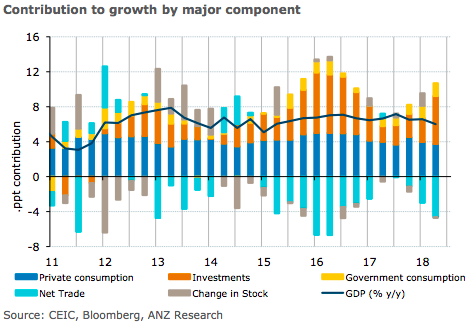
Philippines’ gross domestic product (GDP) for the second quarter of this year, failed to meet market expectations, coming in at 6.0 percent y/y and 1.3 percent q/q on a seasonally adjusted basis, compared to consensus estimates of 6.7 percent y/y. Net exports remained a drag on the overall performance, although domestic demand remained solid with its contribution to headline growth the highest in seven quarters.
At the component level, a 21.2 percent y/y growth in fixed capital formation underpinned the expansion in domestic demand. Private and government consumption grew at a slightly milder pace than that in the first quarter but still recorded solid growth of 5.7 percent y/y and 11.9 percent y/y, respectively. Inventories declined and were a modest drag on overall growth, ANZ Research reported.
Primarily owing to strong import growth of 19.7 percent y/y, the contribution of net exports to overall growth plummeted to -4.7 percentage points. This drag from net exports was the highest since Q2 2016.
"Based on realised H1 growth of 6.3 percent y/y, we are revising our full year 2018 GDP estimate to 6.6 percent from 6.8 percent previously. This downward revision notwithstanding, we remain of the view that domestic demand conditions remain strong and are the principal cause for the deterioration in the trade balance and accelerating inflation," the report commented.







