


 OPEC+ Expected to Hold November Oil Output Quotas Steady
  Best Gold Stocks to Buy Now: AABB, GOLD, GDX
  Asian Currencies Slide as Dollar Rises, Euro Hits 17-Month Low
  Asian Stocks Rise as Nasdaq Record Offsets Bond Yield Pressure
  Thailand Plans Dual-Class Shares to Revive IPO Market
  Euro Hits 17-Month Low as France Debt Fears Boost Dollar
  Wall Street Rises as Oil Prices Ease, Nasdaq Hits Record
  Oil Prices Fall as G7 Reserve Release Eases Supply Fears
  High Rates Weigh on U.S. Home Improvement Demand


 Add as a preferred source on Google
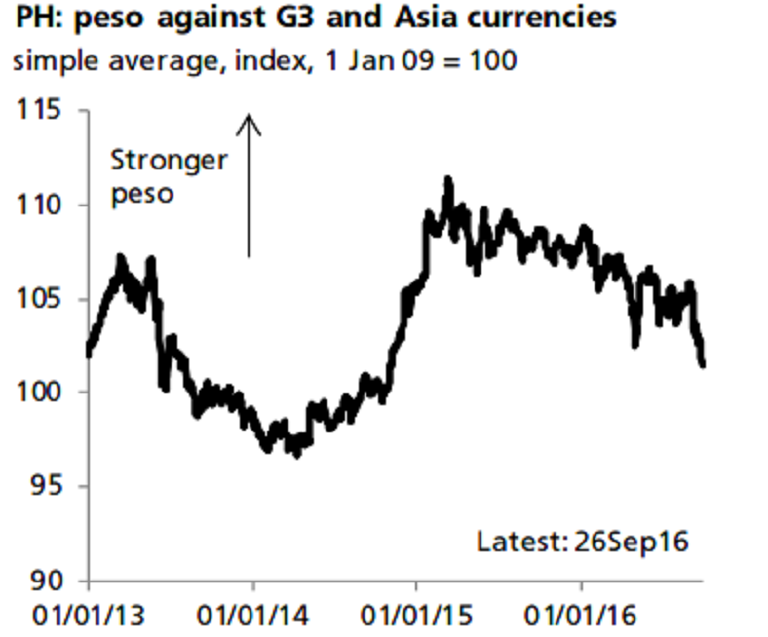
The Philippines peso remained the worst performer amongst all Asian currency pairings over the past one month, following subdued investor confidence in the economy, given that is has been recently shaken by the recent string of negative news about President Duterte.
It is worth noting that up to a month ago, the peso was among the top performers in Asia since 2014. During 2Q14-1Q15, the peso gained almost 15 percent as compared to an average of Asia and G3 currencies.
However, there has been some room for the central bank to tolerate a softer currency, partly as normalization from the outperformance back then. Indeed, comments from government and central bank officials suggest that the policymakers are not too concerned about the peso recent moves, DBS reported.
The current account surplus has narrowed due to a slide in the exports of electronic products, and this might have intensified the central bank’s tolerance of a weak peso. Exports of electronic products were down 8 percent y/y during May-July 2016, a worrying sign given their importance to exports overall.
Meanwhile, domestic demand remains the main driver of overall GDP growth. Double-digit investment growth and private consumption growth, in excess of 6 percent means that the overall GDP growth would comfortably stay above 6 percent.
"Looking far ahead, how the government rolls out its economic policies will certainly have a bearing on foreign interest in the economy. At least for now, the macro picture still looks positive in our view," DBS commented in its latest research note.







