


 Oil Prices Ease as Iran Tensions Clash With Diplomacy Hopes
  Soybean Futures Slip as Traders Await Trump-Xi Trade Signals
  Fed Unveils Stablecoin Rules Under GENIUS Act
  Australia Unemployment Hits Five-Year High Despite Strong Jobs Growth
  Mexico-US Trade Talks Delayed to October as Tariff Negotiations Continue
  Trump, Xi Focus on Trade and AI at White House Summit
  Wall Street Ends Flat as Oil, Treasury Yields and Fed Jitters Rattle Markets
  Best Gold Stocks to Buy Now: AABB, GOLD, GDX
  South Korea, US Discuss Warship Building Cooperation
  Fed Unveils Stablecoin Rules Under GENIUS Act


 Add as a preferred source on Google
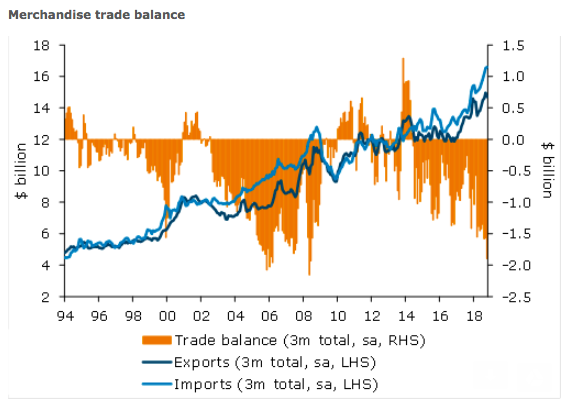
New Zealand’s monthly goods deficit was the third largest on record when excluding large items (aircraft), surpassed only by the previous two months. The annual deficit is now the highest in 11 years.
Imports reached their highest level ever of USD6.2 billion in October, mainly due to petroleum products. Exports also rose strongly as fruit (in particular kiwifruit), meat and forestry products all continued recent strength.
The unadjusted monthly trade deficit pared back USD300 million in October to USD1,295 million. Both exports and imports were slightly higher than expected; petroleum products accounted for a third of the rise in imports. Cell phones and mechanical machinery and equipment also contributed strongly.
On a seasonally adjusted basis, exports fell 6.4 percent m/m, but are hovering around historically high levels. Surprisingly, fruit exports were down 0.9 percent m/m, despite the USD165 million in total kiwifruit exports being the highest on record for an October month. Dairy, meat and forestry products all rose on strong volumes (6 percent, 13 percent and 12 percent respectively).
Seasonally adjusted imports fell 4.6 percent m/m, partially unwinding last month’s revised 9.6 percent lift. Petroleum products fell 15 percent m/m in what typically is volatile data, but major imports such as mechanical and electrical machinery and equipment (cell phones) rose 20 percent and 6 percent apiece. Textiles also rose a solid 18 percent m/m. Overall, imports items came in on the high side and paint a picture of solid domestic demand.
On a regional basis, China continues to command a higher share of New Zealand exports. Exports to China in the past 12 months were $13.5 billion, representing 24 percent of all goods exports. This includes large chunks of New Zealand’s major export groups such as dairy, forestry, meat and fruit exports. By contrast, exports to Australia are just 16 percent of total goods exports.







