


 Oil Prices Jump 3% as Houthi Attack Revives Supply Fears
  Wall Street Falls as Treasury Yields Surge, Oil Rebounds on Iran Tensions
  U.S. Dollar Hits Two-Month High as Oil, Treasury Yields Surge
  Mexico-US Trade Talks Delayed to October as Tariff Negotiations Continue
  Best Gold Stocks to Buy Now: AABB, GOLD, GDX
  European Stocks Slip as Iran Tensions Offset Strong Eurozone Data
  US, China Extend Trade Truce to Jan. 10 Ahead of Trump-Xi Summit
  Japan Private-Sector Growth Slows as Domestic Demand Weakens
  U.S. Treasury Yields Surge as 30-Year Hits 22-Year High
  Soybean Futures Slip as Traders Await Trump-Xi Trade Signals
  South Korea, US Discuss Warship Building Cooperation


 Add as a preferred source on Google
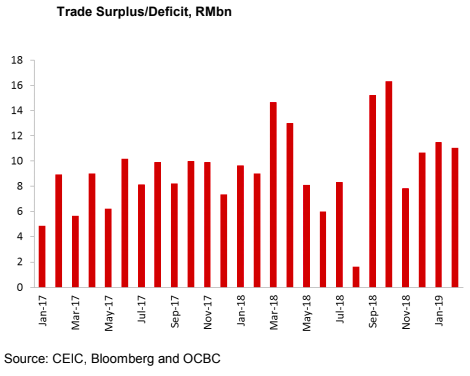
Malaysia’s trade data for February showed the country recording a surplus at RM11.06bn, little changed from the January number of RM11.52 billion. Exports did though record a decline of 5.31 percent y/y, the first since August 2018 whilst imports also fell by 9.43 percent y/y.
However, E&E exports did rise by 4.9 percent y/y, possibly proving that the country may still be in a good position to benefit in some way from the ongoing US – China trade tensions. The Malaysian E&E industry is after all known to be more flexible in quickly adapting to producing new products and hence, able to fill gaps left by China.
Anecdotal evidence also suggests that there is existing spare capacity which means the industry can more quickly respond to additional demand. However, this may also mean that the ongoing trade tensions may not lead to the sector attracting more investment.
Instead, it was commodity related exports which were a drag as petroleum related products, palm oil related products and rubber imports all fell. This could have been due to weaker commodity prices compared to the same time last year. There was an increase in LNG exports as prices were higher although export volumes were lower which possibly highlights continued production weakness in the sector.
On the import side, there wasn’t much good news as intermediate goods imports (57.4 percent of total imports) fell by 2.8 percent y/y reflecting that Malaysia is facing the effects of a global slowdown. Consumer goods and capital goods imports were similarly down too.
"Going forward, even as Malaysia may continue to run a trade surplus, import and export levels may remain subdued given the expected global slowdown in trade as highlighted by the WTO (World Trade Organization) early this week. Even if the US and China sign a trade deal, there are no assurances that they will lift tariffs immediately which is the major negative point on global trade. Oil prices at the same time face downside risk of Trump’s insistence on wanting crude prices to be lower. The palm oil sector meanwhile may be hurt by EU (European Union) attempts to restrict imports," OCBC Treasury Research commented.







