


 Bitcoin ETFs Lose $681 Million, Ending Three-Week Inflow Streak
  XRP Ledger Agentic Payments Surge Past 13 Million Transactions
  Morgan Stanley Raises Coinbase Stock Price Target to $258 Ahead of Earnings
  Cardano Price Drops 14% as ADA Funding Rate Hits Four-Month Low
  Bitcoin Rebounds to $82K as Crypto Market Faces Weekly Losses
  Evernorth Nasdaq Listing Nears as XRP Price Falls
  XRP Whale Activity Drops 27% in Eight Days Amid Market Sell-Off
  DWF Labs Sues BitGo for $114 Million Over Alleged Token Sales Breach
  Dogecoin Price Rises as Bitwise Plans DOGE ETF Closure
  XRP Ledger Activates New Security Feature for Banks and Stablecoins
  Solana Targets 200ms Block Time in Major Network Upgrade
  Crypto Liquidation Flush: BTC & ETH at a Glance
  Chainlink Price Drops 3% Despite New CCIP Vault Launch
  Zcash Plans Quantum-Resistant Security Upgrade for January


 Add as a preferred source on Google
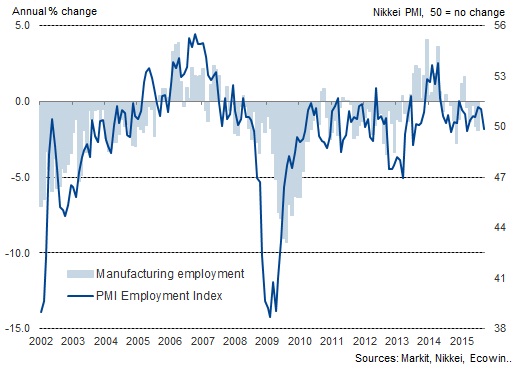
Latest PMI report from Markit economic reveals continued weakness in Japan's economy, which poses question over Abenomics' as well as bank of Japan's (BOJ) ability to revive the economy from decade old deflation.
- While Japanese exporters have surely benefitted from weaker Yen, boosting the appeal for their products around the world, consumers have severely cut back on spending with signs of higher price.
- After years of deflation consumers have gotten used to lower prices and signs are plenty that they are having difficult time adjusting to higher prices, partly driven by weaker Yen and rest by sales tax hike to 8% from previous 5%.
- Japanese government had to postpone, scheduled for this year, another sales tax hike thanks to weaker economy and lower consumer spending.
Today's flash PMI report showed that Japan's manufacturing headline reading is to slow to 50.9 in September from 51.7 in August.
Moreover as shown in chart, employment at factory level dropped for the first time in six months, which clearly suggests that manufacturers are not too upbeat on Japan as well as global economy. However that is not likely to affect overall unemployment level, which stands around 3.3%, one of the lowest in the world.
Japanese Nikkei is down -0.5% today, while yen is up 0.22% against Dollar, trading at 120.







