


 Asian Currencies Muted as Dollar Firms Ahead of Trump-Xi Summit
  Mexico-US Trade Talks Delayed to October as Tariff Negotiations Continue
  Asian Stocks Mixed Ahead of Trump-Xi Meeting
  FxWirePro: Daily Commodity Tracker - 21st March, 2022
  Japan Private-Sector Growth Slows as Domestic Demand Weakens
  Gold Prices Fall as Treasury Yields Rise on Fed Rate Hike Bets
  US Stock Futures Fall as Treasury Yields Surge Ahead of Trump-Xi Summit
  European Stocks Slip as Iran Tensions Offset Strong Eurozone Data
  US Dollar Hits Two-Month High as Fed Rate Hike Bets Rise
  Wall Street Falls as Treasury Yields Surge, Oil Rebounds on Iran Tensions
  Oil Prices Ease as Iran Tensions Clash With Diplomacy Hopes


 Add as a preferred source on Google
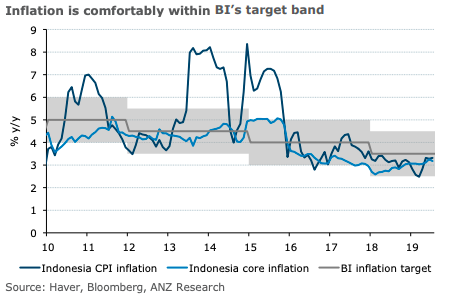
Indonesia’s inflation is likely to stay comfortably within the central bank’s 2.5-4.5 percent target band despite the higher than anticipated July print, according to the latest report from ANZ Research.
The country’s both headline and core CPI inflation beat consensus expectations. Headline CPI inflation edged up to 3.32 percent y/y in July, while core inflation softened less than expected to 3.18 percent y/y. An increase in the price of administered items offset softening core and flat volatile food inflation.
Four categories including foodstuffs, housing and utilities, prepared food and health which cumulatively account for around 65 percent of headline CPI recorded easing annual inflation. However, this was offset by increases in the clothing and transport components.
Notably, transport prices picked up to 2.2 percent y/y in July from 1.9 percent in June. In sequential terms, headline CPI rose by 0.31 percent m/m in July, lower than the 0.55 percent m/m increase in the prior month. The pace of increase eased in all components except for education.
Core CPI, which excludes volatile food and government-controlled prices, rose by 0.33 percent m/m in July, marginally lower than the 0.38 percent increase recorded in June. In y/y terms, core inflation eased to 3.18 percent y/y, from 3.25 percent in the previous month.
"The big picture is that inflation remains under control and comfortably within the central bank’s 2.5-4.5 percent target band. We continue to see scope for the policy rate to be lowered by 50bps over the coming quarters," the report further commented.







