


 TrumpRx Website Launches to Offer Discounted Prescription Drugs for Cash-Paying Americans
  FDA Targets Hims & Hers Over $49 Weight-Loss Pill, Raising Legal and Safety Concerns
  Nvidia CEO Jensen Huang Says AI Investment Boom Is Just Beginning as NVDA Shares Surge
  OpenAI Expands Enterprise AI Strategy With Major Hiring Push Ahead of New Business Offering
  Sony Q3 Profit Jumps on Gaming and Image Sensors, Full-Year Outlook Raised
  Amazon Stock Rebounds After Earnings as $200B Capex Plan Sparks AI Spending Debate
  Prudential Financial Reports Higher Q4 Profit on Strong Underwriting and Investment Gains
  Once Upon a Farm Raises Nearly $198 Million in IPO, Valued at Over $724 Million
  Alphabet’s Massive AI Spending Surge Signals Confidence in Google’s Growth Engine



As massive new airports open across Asia and the Middle East, U.S. airports are enhancing security checkpoints with technological gadgets to screen passengers and luggage more quickly. All these projects are often touted as “airports of the future,” in which air travel will be faster, more efficient and more enjoyable than ever before.
However, as a scholar of the history of U.S. airports, I’m most interested to see that all these shiny improvements are still struggling to solve the problems that have vexed airport managers and passengers since at least the late 1950s. Even at the dawn of the jet age, airlines had trouble moving people and bags through airports – and they still do. It’s unclear that bigger airports serving ever more passengers will have an easier time than their smaller, less crowded predecessors.
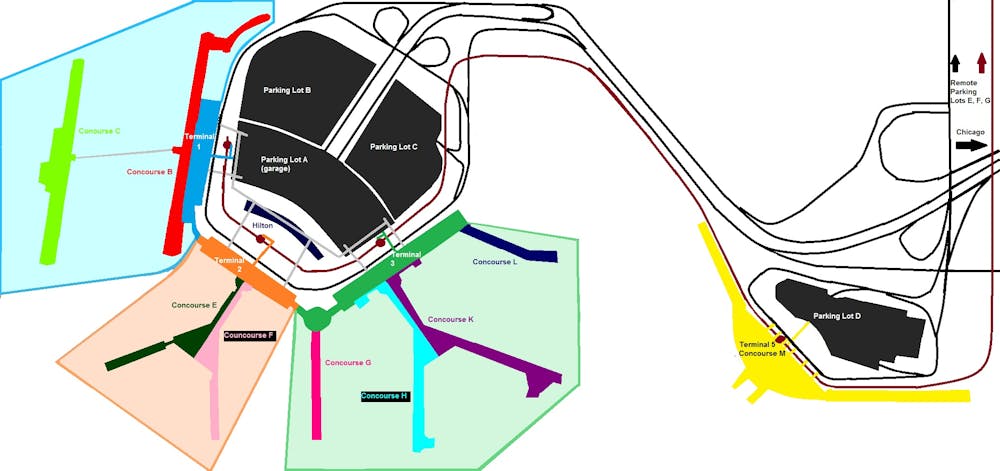
Chicago’s O'Hare, one of the nation’s busiest airports, stretches across an area one-third the size of Manhattan. Jay8g/Wikimedia Commons, CC BY-SA
A long way to walk
When commercial jet airliners came to the U.S. in the late 1950s, they were larger and faster than previous planes, needing longer runways and more space to park and maneuver on the tarmac. They carried more passengers, which meant boarding gates had to be bigger. This led to the now-familiar design called “pier-finger terminals,” with a main terminal screening passengers and collecting checked luggage, beyond which lay long stretches of boarding gates, spaced far enough apart for planes to fit side by side. Atlanta, Chicago and Miami airports all were criticized for making passengers walk nearly half a mile from ticketing to their gates.
Eero Saarinan, designer of classic jet-age terminals at Dulles and Kennedy airports, proposed two different answers. At Dulles, outside Washington, D.C., he called for large, bus-like vehicles to move passengers from the terminal directly to their airplanes. Called “mobile lounges,” they’re now being phased out in favor of another system billed as more future-oriented: an underground train.
People-moving ‘mobile lounges’ at Dulles International Airport.
In his TWA terminal at JFK Airport outside New York City, Saarinan planned for moving sidewalks to help people cover the distance. The final construction didn’t end up including them, but many large airports adopted the idea.
Those approaches did reduce the number of steps passengers had to take. But as terminals grew in size and airline routes became more complex, passengers had to change planes more often. That has required trains or trams to help people travel longer distances within terminals, or even to other concourses.
Checked luggage has to travel farther, too. In the late 1980s and early 1990s, Denver officials thought they had the ultimate futuristic solution with an automatic bag handling system. After repeated failures, though, the machines were shut down and baggage handling was put back in human hands.
After decades of attempts, the best way to ensure you and your bags arrive at the same place at the same time is carrying them on the plane yourself. Of course, that means you have to drag heavier bags even farther through sprawling airports.
Planning for the unexpected
After the 2001 terrorist attacks, new security screenings created long lines and increased the amount of time people spent at the airport before flights. The need for additional security and waiting space challenged designs that had seemed forward-thinking even in the late 1990s.
For instance, a terminal completed in 1997 at Reagan National Airport outside Washington, D.C., included shops and restaurants, as well as a seamless link to the region’s public transit system. That whole layout is being revamped now, at a cost of US$1 billion, to enhance the travel experience and to accommodate growing passenger numbers.
As more people fly more often, the pace of growth and unexpected events have often overwhelmed the best intended designs and plans. After more than 60 years of trying, it’s an open question whether the ultimate airport of the future – one where passengers and their bags move quickly through a space that’s enjoyable to be in – could ever exist at all.














