


 Europe can’t achieve space sovereignty alone. Here’s why
  RBNZ Raises Interest Rate to 2.75%, Kiwi Dollar Slides
  fnny Beta Launches With a Simple Idea: Find an Event, Show Up, Get Rewarded
  RBA Says ASX Still Falls Short on Governance and Risk Controls
  US Gas Market Poised for Supercycle: Bernstein Analysts
  Hawkish Fed Fuels Gold Sell-off: Gold Dives Below $4300 Amidst Rate Hike Fears
  Global Markets React to Strong U.S. Jobs Data and Rising Yields
  Fed Rate Hike Threatens Housing as U.S. Growth Leans on AI, Citi Says
  BOJ Set for Rate Hike as Inflation and Yen Pressure Mount
  China Boosts Gold Reserves by 650,000 Ounces as Prices Rally


 Add as a preferred source on Google
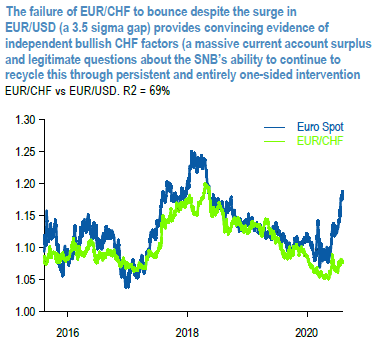
USDCHF has served us well as a proxy EURUSD long. But this is far from being the only reason to hold a CHF long. The chart demonstrates EURCHF that is now nearly seven cents too low given the surge in EURUSD, an undershoot that we take to be compelling evidence of the independently bullish factors that have boosted CHF, and will likely continue to do so.
In essence this is a current account disequilibrium on steroids, insofar as Switzerland found it almost impossible to recycle its 10% of GDP current account surplus even before the onset of global financial repression, hence the reliance on persistent SNB intervention to generate the necessary capital outflows.
There is no definitive limit on the SNB’s ability to continue with this policy to blunt fundamentally justified CHF appreciation in this way; nevertheless, we suspect that an adverse finding by the UST about currency manipulation in its next report would increase pressure on the SNB to scale back its activities and permit rather more CHF appreciation.
While such a finding is not necessarily guaranteed even if Switzerland does now satisfy the three objective criteria to identify manipulation criteria, we continue to regard the forthcoming report as an important asymmetric risk factor for CHF, one that is worth pre-positioning for. Trade tips: Stay short in USDCHF at 0.924. Marked at +1.73%. Courtesy: JPM







