


 China's Refining Industry Faces Major Shakeup Amid Challenges
  U.S. Banks Report Strong Q4 Profits Amid Investment Banking Surge
  FxWirePro- Crypto Weekly Alpha: ETF Rebounds, L2 Rallies & Key Resistance Levels
  What is Zionism? The different meanings of a contested term
  Yen in Focus as BOJ, Fed Rate Hikes Reshape Currency Markets
  China Boosts Gold Reserves by 650,000 Ounces as Prices Rally
  Fed Rate Hike Threatens Housing as U.S. Growth Leans on AI, Citi Says
  BOJ Raises Interest Rate to 31-Year High as Yen Weakens


 Add as a preferred source on Google
The Russian rouble had weakened earlier in the spring, driven jointly by a collapse of the oil price and collapse of world economic activity. But when both these factors stabilised, the currency was able to rally noticeably and this, in fact, drove the central bank to accelerate the pace of its rate cuts. CBR used a large 100bp rate cut step in June before reverting to the smaller 25bp step in July. The outlook for the oil price has also become risky because of second wave fears. As a result of such developments, modest rouble underperformance is to be expected in the near-term. We could foresee USDRUB at 72.00 levels by Q3’2020 end, but forecast the exchange rate to trade at around the 70.00 mark by the year-end.
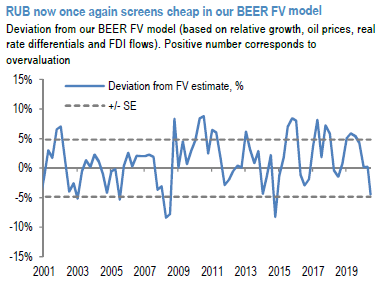
RUB should also benefit from an improved technical backdrop. Following the seasonal pressures, valuations once again appear attractive. We refer to JP Morgan’s BEER FV model that points to an undervaluation of around 3.4% (close to one standard deviation). This compares to an overvaluation of around 5%, when we first initiated tactical hedges (refer 1st chart). Ruble positioning remains relatively elevated in the latest J.P. Morgan client survey, with a score of +2.2 (ranking it the second largest EM FX OW in our survey).
However, we note higher frequency measures of spec positioning, as captured by IMM data, so positioning has been reduced over the past number of weeks (refer 2nd chart).
Accordingly, we saw this as an opportune time to take profits on USDRUB call spreads. With dividend pressure now abating and valuations once again screening cheap, positions have been squared-off and booked 0.86% of notional profit on tactical 1x1 USDRUB call spread (entry date: 30 June; spot ref of 71.74; exit spot ref of 74.01; option price at entry: 0.91%, option price at exit: 1.77%; profit: 0.86% of notional). We, now, maintain OW RUB in the GBI-EM model portfolio, expecting outperformance on an RV basis against fundamentally weaker high yielders in this region. Courtesy: JPM & Commerzbank







