


 Lithium Market Poised for Recovery Amid Supply Cuts and Rising Demand
  Oil Prices Dip Slightly Amid Focus on Russian Sanctions and U.S. Inflation Data
  Moody's Upgrades Argentina's Credit Rating Amid Economic Reforms
  FxWirePro- Crypto Weekly Alpha: ETF Rebounds, L2 Rallies & Key Resistance Levels
  fnny Beta Launches With a Simple Idea: Find an Event, Show Up, Get Rewarded
  U.S. Treasury Yields Expected to Decline Amid Cooling Economic Pressures
  Gold Prices Fall Amid Rate Jitters; Copper Steady as China Stimulus Eyed
  Who should own the knowledge that underpins AI technology?
  Moldova Criticizes Russia Amid Transdniestria Energy Crisis


 Add as a preferred source on Google
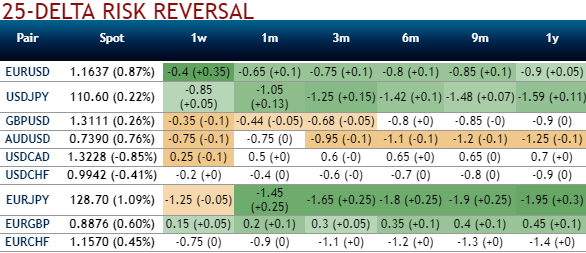
Before we move onto strategies, let’s just glance through the risk reversals of USDCAD for short-term tenors are showing minor changes (changes only in 1w expiries), while bullish hedging bids remain intact for the long-term. While the IV skews are also positive for 1w tenor is slightly stretched out for OTM puts, while the 3m IVs are still positively skewed which means bullish risks remain intact despite the above stated fundamental factors.
While 1w forward rates show negligible changes and bearish targets in the longer tenors.
Accordingly, we uphold staying short USDCAD through a low-cost RKO: The USDCAD put RKO was originally conceived as a low-cost option to gain exposure to what seemed like a decent chance of a near-term breakthrough in NAFTA negotiations.
Now what seems most likely is that the option will expire worthless, particularly after the latest developments in the US Trade policy which seemingly swung the tone of NAFTA negotiations back to an antagonistic one where Trump has once again publically hinted about the possibility of pulling out.
Hence, we advocate staying short in 1w USDCAD forwards with a view to arresting potential bearish risks in the near-term and longs in 3m forwards.
Alternatively, Buy 2m 1.29 USDCAD put, RKO 1.25 for 14bp, spot reference: 1.3183.
Currency Strength Index: FxWirePro's hourly CAD spot index is flashing at 172 levels (which is bullish), while hourly USD spot index was at -5 (neutral) while articulating at (14:16 GMT). For more details on the index, please refer below weblink:
http://www.fxwirepro.com/currencyindex
FxWirePro launches Absolute Return Managed Program. For more details, visit:







