


 Moody's Upgrades Argentina's Credit Rating Amid Economic Reforms
  fnny Beta Launches With a Simple Idea: Find an Event, Show Up, Get Rewarded
  Goldman Predicts 50% Odds of 10% U.S. Tariff on Copper by Q1 Close
  Hawkish Fed Fuels Gold Sell-off: Gold Dives Below $4300 Amidst Rate Hike Fears
  U.S. Banks Report Strong Q4 Profits Amid Investment Banking Surge
  Bank of America Posts Strong Q4 2024 Results, Shares Rise
  Stock Futures Dip as Investors Await Key Payrolls Data
  Gold Prices Slide as Rate Cut Prospects Diminish; Copper Gains on China Stimulus Hopes
  Who should own the knowledge that underpins AI technology?
  FxWirePro- Crypto Weekly Alpha: ETF Rebounds, L2 Rallies & Key Resistance Levels
  Moldova Criticizes Russia Amid Transdniestria Energy Crisis


 Add as a preferred source on Google
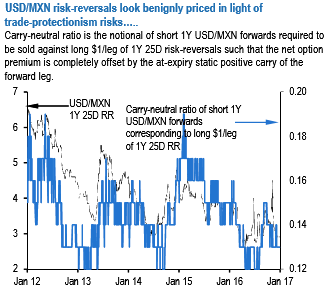
We are a little surprised at how well risk markets and EM currencies have traded despite a slew of trade protectionist-leaning appointments to the Trump cabinet over the past few weeks. As noted in our 2017 FX Outlook, we expect the trade issue to prominently feature in the US policy agenda before long, and Mexico stands in the direct line of fire of the conflict as evinced by this week’s sharp reaction in MXN spot and vols following anti-trade tweets from the President Elect.
Our Latin America strategists note that Banxico has severely limited reserve firepower to counter a potential regime change in US external policy, and that a renegotiation of NAFTA could push USD/MXN levels even upto as high as 25. Yet USD/MXN risk-reversals look decidedly benign in the light of these risks–1Y skews are back to pre-election levels and near 5-yr tights –and like CNH, particularly in comparison to elevated MXN implied yields that top 7% in 1-yr and out expiries (see above chart).
One possibility is that depressed riskies are an artifact of USD call/MXN put selling flows from real money yield harvesting programs, but we doubt those will be able to impose a cap on option markets in the event of a shock, and investor positioning in MXN based on JPM client surveys does not appear heavily short in a way that can mute realized vol and realized spot-vol correlations in a sell-off.
Along the lines of CNH therefore, partially delta-hedged USDMXN risk-reversals (carry-neutral ratio 0.13) strike us as a more efficient way of carrying short MXN risk than forward outrights. While not as exposed to Mexico trade tensions, USDZAR is another EM currency where risk reversals do not discount much likelihood of EM stress, and a target for establishing short risk positions in anticipation of trade-conflict spilling over onto the broader EM complex.







