


 2025 Market Outlook: Key January Events to Watch
  Urban studies: Doing research when every city is different
  Gold Prices Fall Amid Rate Jitters; Copper Steady as China Stimulus Eyed
  Yen Sinks as BOJ Rate Hike Fails to Impress Markets
  UBS Projects Mixed Market Outlook for 2025 Amid Trump Policy Uncertainty
  European Stocks Rally on Chinese Growth and Mining Merger Speculation
  UBS Predicts Potential Fed Rate Cut Amid Strong US Economic Data
  Lithium Market Poised for Recovery Amid Supply Cuts and Rising Demand
  U.S. Stocks vs. Bonds: Are Diverging Valuations Signaling a Shift?
  BOJ Raises Interest Rate to 31-Year High as Yen Weakens
  RBA Says ASX Still Falls Short on Governance and Risk Controls
  US Futures Rise as Investors Eye Earnings, Inflation Data, and Wildfire Impacts
  Global Central Banks Brace for More Rate Hikes as Inflation Risks Rise


 Add as a preferred source on Google
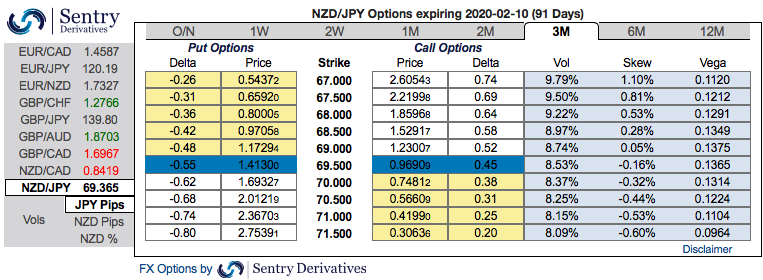
The RBNZ is scheduled for their monetary policy this week. The kiwis central bank cut 50 bps in its August meeting and had said that there was room to cut further "if required." We interpret this as an easing bias rather than a signal. In other words, the RBNZ views a cut as more likely than a hike, but is not committing to either at this point.
They have demonstrated its willingness to take bold steps, which means markets are likely to remain dovishly positioned for some time. As discussed in our recent posts, we now think the odds favor the further RBNZ rate cut the OCR to a new low of 0.75% in November. Combined with easing from other central banks, that should push NZ swap rates to fresh record lows.
Hence, we reckon that the prevailing rallies of NZDJPY are momentary, NZD is expected to depreciate towards 67 levels by year-end.
The global risks are reckoned to play less conducive for NZ than they do for Australia, and the central bank has reason to be credibly dovish even as the data have outperformed some of the downside risk scenarios laid out earlier in 2018. The pair is forecasted to depreciate below 67 levels by year-end.
While the NZDJPY trade is underwater following positive news reports on a US-China agreement. The erratic nature of news flow is one reason why we had suggested NZDJPY shorts via options in the past, suitable options strategy is designed favoring bearish side.
OTC Updates, Trade and Hedging Recommendations:
3m IV skews are right indications for NZD that have clearly been indicating bearish risks. The major downtrend continuation shouldn’t be panicked the broad-based bearish outlook amid minor rallies.
The positively skewed IVs of 3m tenors signify the hedgers’ interests to bid OTM put strikes up to 67.00 levels (refer above nutshells evidencing IV skews).
Hence, initiate longs in -0.49 delta put options of 3m tenors, simultaneously, short (1%) out of the money put options of the narrowed expiry (preferably 2w tenors), the strategy is executed at net debit (spot reference: 69.399 levels).
Well, a higher (absolute) Delta value is desirable on long leg in the above stated strategy. Whereas, the Theta is positive on short leg; as the time decay is good for an option writer (that’s why we’ve chosen narrowed expiry). The short side likely to reduce cost of hedging with time decay advantage on short leg, while delta longs likely to arrest potential bearish risks.
Alternatively, shorts in the mid-month futures have already been advocated with a view of arresting the downside risks. We wish to uphold the same short hedge strategy of mid-month tenor that was advocated in our previous post.
One can also buy tunnel options spreads with upper strikes at 69.420 and lower strikes at 69.323 levels on the trading grounds. Courtesy: Sentrix







