


 Vietnam, US Trade Deal Could Be Signed Soon, To Lam Says
  Wall Street Surges as Meta Leads AI Rally, Oil Prices Fall
  U.S. Dollar Hits Eight-Week High After Fed Rate Hike
  Yen Weakens as Dollar Gains on Widening US-Japan Rate Gap
  US Stock Futures Rise as Meta Muse Fuels AI Rally
  Oil Prices Rise as U.S.-Iran Talks Fuel Diplomacy Hopes
  US-China Talks Target AI, Tariffs Ahead of Trump-Xi Summit
  Yen in Focus as BOJ, Fed Rate Hikes Reshape Currency Markets
  RBA Says ASX Still Falls Short on Governance and Risk Controls
  France Debt-to-GDP Ratio Seen Hitting Record 119.3% in 2026
  Vietnam Stocks Join FTSE Emerging Market Indexes, Unlocking Billions in Foreign Investment
  Gold Prices Hold Steady Ahead of Trump-Xi Summit, Middle East Risks
  Dollar Hits Two-Month High as Fed Rate Hike Bets Rise
  European Stocks Slip as Iran Tensions Offset Strong Eurozone Data
  Gold Prices Rise as Oil Slump Eases Fed Rate Hike Fears
  Gold Prices Rise as Oil Slide Eases Fed Rate Hike Fears


 Add as a preferred source on Google
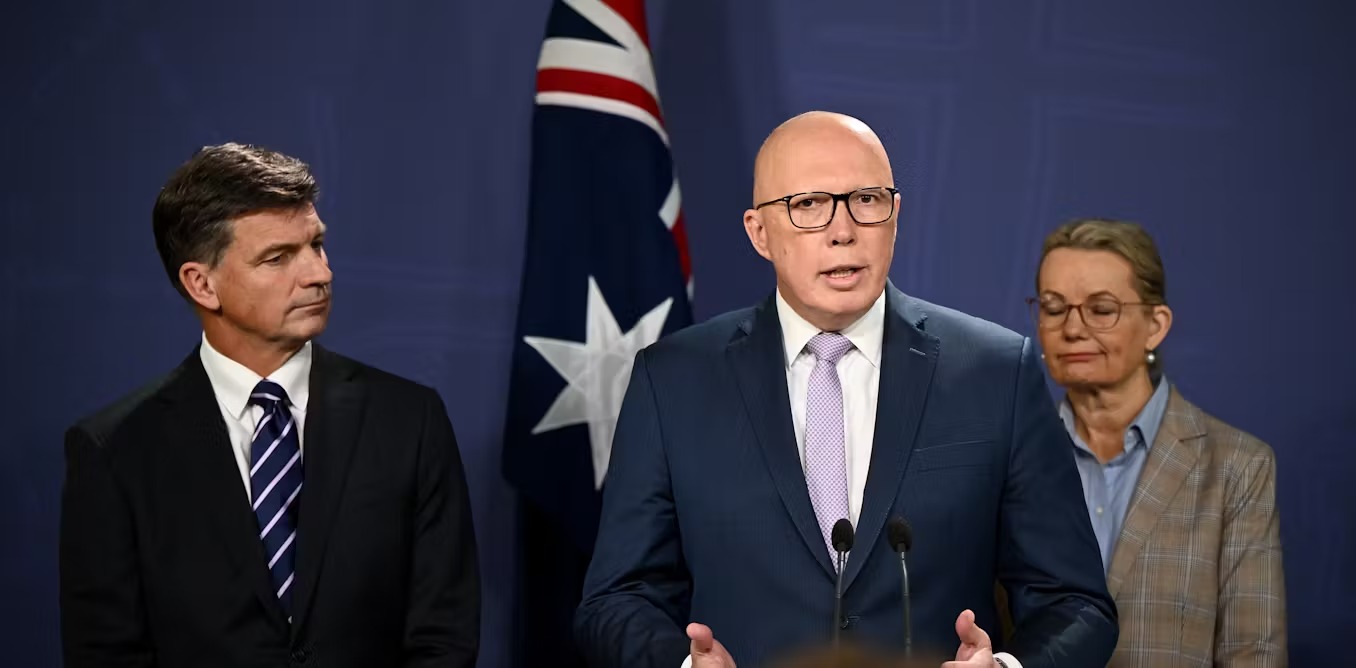

Opposition leader Peter Dutton has announced seven sites for reactors, unveiling his long-awaited and highly-controversial policy for nuclear power with the claim it could start operating from the 2030s.
The locations are the sites of former or current coal plants. They have the technical attributes needed for a nuclear plant, including transmission infrastructure, cooling water capacity and a skilled workforce, the opposition policy says.
The program would consist of two phases, starting with two establishment projects in the mid-2030s followed by a build of others through to 2050.
Most sites would have larger reactors, with two – in South Australia and Western Australia – having small modular reactors. All mainland states would eventually have reactors.
The proposed sites are
-
Liddell Power Station, New South Wales
-
Mount Piper Power Station, New South Wales
-
Loy Yang Power Stations, Victoria
-
Tarong Power Station, Queensland
-
Callide Power Station, Queensland
-
Northern Power Station, South Australia (small modular reactor only)
-
Muja Power Station, Western Australia (small modular reactor only)
Dutton said the generators would be owned by the Commonwealth government.
The first could begin operating in 2035 if small modular reactors are used, or 2037 “if modern larger plants are found to be the best option”, the opposition says.
This is much earlier than the CSIRO has estimated that an initial plant could begin.
The CSIRO said in its May assessment of generation technology costs for Australia, that “due to the current state of the development pipeline in Australia, that the earliest deployment would be from 2040”.
Dutton said he would be “very happy for the election to be a referendum on energy, on nuclear, on power prices, on lights going out, on who has a sustainable pathway for our country going forward”.
“We are going to the next election seeking a mandate from the Australian people, a very clear mandate that we want support to modernise our energy system … which is about economic growth and jobs for decades and generations to come,” Dutton said. said.
This is the concept design of a zero emissions small modular reactor.
— Peter Dutton (@PeterDutton_MP) June 19, 2024
Nuclear energy has proven to get electricity prices and emissions down all over the world.
Out of the world’s 20 largest economies, Australia is the only one not using nuclear energy or moving towards it.… pic.twitter.com/BN00QxQMmd
The opposition says the timeline for nuclear energy including building two establishment projects is ten to 12 years, “from the government making a decision until zero-emissions nuclear electricity first enters the grid”.
The Coalition policy says a key advantage of the nuclear energy plants was they could be plugged into existing grids. “This means they can effectively replace retired or retiring coal plants and avoid much of the new spending needed for Labor’s ‘renewables-only’ system, including new transmission poles and wires.”
The government would partner with nuclear companies from aboard on development and operation.
Each community around a site would receive a benefits package enshrined in legislation.
It would include:
-
multi-billion dollar facility guaranteeing high-paying jobs for generations to come
-
an integrated economic development zone attracting manufacturing, value-add and high-tech industry
-
a regional deal unlocking investment in modern infrastructure, services and community priorities.
Establishing a civil nuclear programme would require an expanded Australian Radiation Protection and Nuclear Safety Agency to license and regulate the power stations, a Nuclear Energy Coordinating Authority, and a government business enterprise to be called Affordable Energy Australia.
Dutton could not give a cost for the nuclear plan, saying only it would be “a fraction” of the government’s energy transition plan costing $1.2 trillion to $1.5 trillion. He said the opposition would have more to say on cost “in due course”.
The opposition leader announced his plan at a news conference in Sydney, after a pre-budget announcement had been deferred. He was flanked by a bevy of colleagues including Nationals leader David Littleproud.
Treasurer Jim Chalmers said in a social media post: “With Australia’s advantages and opportunities, nothing could be more economically irrational or fiscally irresponsible” than the nuclear policy".
This economic vandalism we see on energy from the Coalition should be disqualifying for a major party seeking to govern.
— Jim Chalmers MP (@JEChalmers) June 18, 2024
Chalmers told the ABC: “Peter Dutton’s nuclear negativity is economic insanity, pure and simple. Nuclear takes longer, it costs more and it will squander Australia’s unique combination of advantages”.
Apart from a fierce campaign from federal Labor, Dutton faces attacks from the states. His plan is opposed by the Liberal-National opposition in Queensland where there is a state election within months.







