


 Gold Drops Over 1% as Dollar, Treasury Yields Surge on Fed Rate Hike Bets
  Asian Stocks Mixed Ahead of Trump-Xi Meeting
  Gold Prices Rise as Oil Slide Eases Fed Rate Hike Fears
  Gold Prices Fall Amid Rate Jitters; Copper Steady as China Stimulus Eyed
  Oil Prices Extend Losses as U.S.-Iran Talks Ease Supply Fears
  Wall Street Surges as Meta Leads AI Rally, Oil Prices Fall
  Gold Prices Rise as Oil Slump Eases Fed Rate Hike Fears


 Add as a preferred source on Google
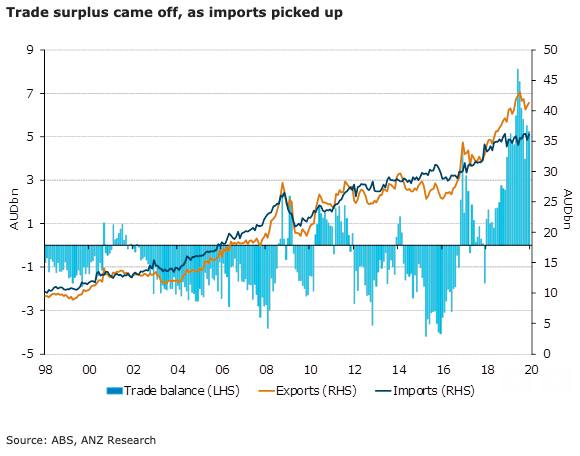
Australia’s trade surplus fell slightly to AUD5.2 billion in December, below market expectations. The decline was driven by a larger rise in imports compared to exports. Imports rose 2.4 percent m/m, while exports were up 1.4 percent m/m.
Stronger resource exports were the primary drivers of the pick-up in exports, while service exports fell. Imports were up across the board, with sharp rises in capital and consumption goods imports.
Total resource exports rose 2.9 percent m/m in December and are now 12.1 percent higher than a year ago. The increase largely reflects higher iron ore exports, which rose 3.3 percent m/m, as well as LNG, up 2.6 percent m/m.
Non-monetary gold continued its recent volatility rising 14 percent m/m after declining 6 percent in the previous month. The RBA’s commodity price index was down 1.1 percent in December, which suggests that the rise in resource exports was likely due to a rise in volume.
Manufacturing exports continued to decline, by 3.3 percent m/m. Service exports had the first material decline in some time, falling 1.1 percent m/m.
Capital goods were up 6 percent m/m, leading the increase in imports. A large part of this was due to increased transport equipment imports, which rose 23 percent m/m. Consumption goods had a strong month, largely reversing the decline from November. Fuel imports, for example, were up 4.7 percent m/m.
"Given the preliminary December quarter trade balance, net exports are unlikely to contribute much to GDP growth," ANZ Research commented in its latest report.







