


 Asian Currencies Rise as Dollar Hovers Near Multi-Month Lows
  Gold’s Bull Run Intact: Safe-Haven Bids Overpower Treasury Yield Pressure
  Switzerland Industrial Production Jumps 5.5% in Q2 2026
  Gold Prices Edge Higher as Dollar Weakens Ahead of Fed Minutes
  RBI Holds Repo Rate at 5.25% as Inflation Risks and Global Uncertainty Persist
  Japan Trade Deficit Widens as Imports Surge on Energy and AI Demand
  Morgan Stanley Sees Fed Holding Rates as U.S. Inflation Cools
  Japan Government Backs Earlier BOJ Rate Hike as Inflation Pressures Build
  Schott Pharma Stock Rises as Barclays Upgrades Rating on Growth Outlook
  Fed Minutes Signal Rate Hikes Remain Possible as Inflation Risks Persist


 Add as a preferred source on Google
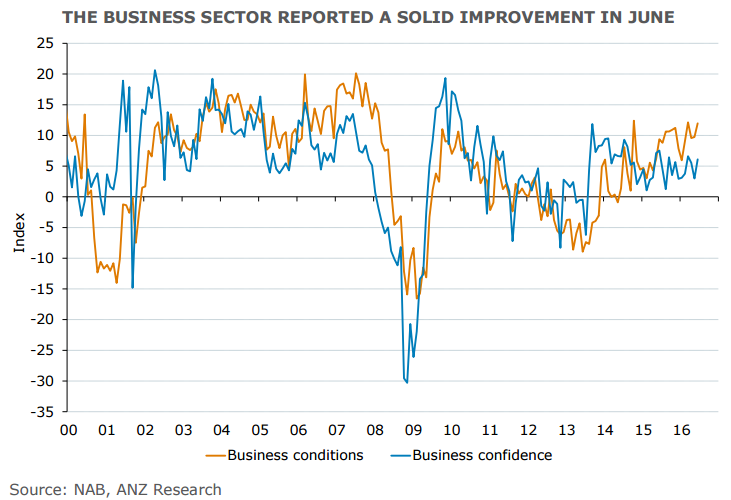
NAB’s closely-watched business survey for June tested the sentiment of local firms amidst the uncertainty of the federal election as well as the political unease in Europe and consequent market turbulence. The NAB business confidence index rose to 6.0 in May from 3.0 in the previous month. The index measuring forward orders and capital expenditure both improved during June. Business conditions also lifted from their already elevated level to +12 index points from +10 in the previous month.
The rise in business conditions was due to a notable improvement in employment demand, although profitability also rose, while trading conditions were unchanged at very elevated levels. Employment conditions are now back above long-run average levels, suggesting solid near-term employment growth. The results point to further improvement in the non-mining economy in Q2, with growth potentially becoming more broad-based.
“This suggests that firms are looking through external uncertainties, choosing to focus on the positives they see in their own business, at least for the time being,” NAB chief economist Alan Oster said.
The RBA should be reasonably comfortable with the present state of economic conditions and also the resilience of business confidence and business conditions in the wake of recent events that cloud the outlook. That said, inflation measures in the survey were broadly steady, although a drop in retail prices may have implications for CPI. Lacklustre views on inflation point to an opportunity for the Reserve Bank to further cut record low rates later this year.
Australia's inflation fell to multi-year low in Q1. In the first quarter of 2016, consumer prices fell 0.2% over the previous quarter, undershooting market analysts' expectations of a 0.3% increase and contrasting Q4 2015's 0.4% increase. NAB considers the report a mixed bag for the Reserve Bank to digest, with the lack of inflationary pressure leaving the door open to an August rate cut despite signs of robust economic growth.
“These trends justify the highly accommodative setting for monetary policy, but while the August RBA meeting (post Q2 CPI) is likely to be ‘live’, current information suggest rates will remain on hold — although it is likely to be a close call,” NAB said.
Aussie buoyed by robust data. AUD/USD hits new 2-week highs at 0.7637. Technicals support upside in the pair. The pair finds next hurdles at 0.7647 (June 24 high) and then at 0.7687 (78.6% Fib of 0.7835 to 0.7145 fall).







