


 Wall Street Falls as Treasury Yields Surge, Oil Rebounds on Iran Tensions
  China’s ‘Lipstick King’ Says AI Won’t Replace Livestream Hosts
  Trump, Xi Focus on Trade and AI at White House Summit
  European Stocks Fall as Bond Yields and Geopolitical Risks Weigh
  US, China Extend Trade Truce to Jan. 10 Ahead of Trump-Xi Summit
  Dollar Hits Two-Month High as Fed Rate Hike Bets Rise
  Russian Envoy Dmitriev Heads to US for Ukraine Talks
  FxWirePro: Daily Commodity Tracker - 21st March, 2022
  Japan Private-Sector Growth Slows as Domestic Demand Weakens


 Add as a preferred source on Google
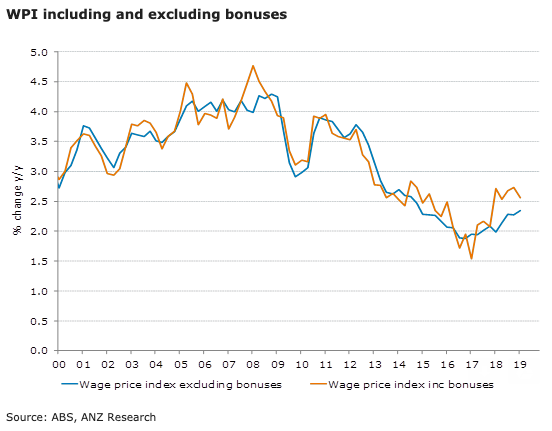
Australia’s annual wage growth steadied at 2.3 percent in Q1 2019. The quarterly result of 0.5 percent was marginally lower than expected but wasn’t far off 0.6% at two decimal places. Annual growth in wages including bonuses slowed from 2.7 percent to 2.6 percent.
It was a tale of two sectors: the public sector recorded its slowest quarterly growth in 19 years, while the private sector saw the strongest annual growth in four years.
The wage price index (WPI) rose by 0.5 percent q/q and 2.3 percent y/y in Q1. The quarterly result was slightly below market and our expectations; however, for the second quarter in a row, it was very close to being 0.6 percent (at 0.54 percent).
Public sector wage growth slowed again to 0.4 percent q/q, the weakest result since 2000, dropping annual growth to 2.4 percent. Private sector wages were steady at 0.5 percent q/q, upping annual growth to 2.4 percent, the strongest result in four years.
Including bonuses, public sector wages slowed to 2.4 percent y/y (from 2.5 percent) and private sector wages slowed to 2.7 percent y/y (from 2.8 percent).
Across industries, construction saw the slowest wage growth, at 1.8 percent (down from 1.9 percent), followed by information media and telecommunications and retail trade. Health care maintained the strongest wage growth at 3.0 percent. Mining (1.8 percent to 2.3 percent) and professional services (2.1 percent to 2.5 percent) improved the most.
New South Wales saw annual wage growth slow from 2.4 percent to 2.3 percent, with growth in South Australia and Tasmania also slowing. The Northern Territory (2.2 percent to 2.4 percent) and the ACT (2.0 percent to 2.1 percent) recorded an acceleration in wage growth. Victoria maintained the strongest wage growth rate nationally of 2.7 percent, while Western Australia remained in the weakest position at 1.6 percent.
"The mixed results do not provide a clear signal to the RBA. Firms are finding it more difficult to source suitable labour, and labour underutilisation rates have declined, but wage growth is picking up at a glacial pace. Labour underutilisation needs to drop faster to generate faster wage growth," ANZ Research commented in its latest report.







