


 US, China Extend Trade Truce to Jan. 10 Ahead of Trump-Xi Summit
  Soybean Futures Slip as Traders Await Trump-Xi Trade Signals
  US Dollar Hits Two-Month High as Fed Rate Hike Bets Rise
  U.S. 10-Year Treasury Yield Hits 2007 High as Fed Rate Hike Bets Rise
  Gold Prices Fall as Treasury Yields Rise on Fed Rate Hike Bets
  US 10-Year Treasury Yield at 6% Emerges as New Market Risk Threshold
  Dollar Hits Two-Month High as Fed Rate Hike Bets Rise
  Wall Street Falls as Treasury Yields Surge, Oil Rebounds on Iran Tensions
  Australia Unemployment Hits Five-Year High Despite Strong Jobs Growth
  China’s ‘Lipstick King’ Says AI Won’t Replace Livestream Hosts
  European Stocks Slip as Iran Tensions Offset Strong Eurozone Data
  Japan Private-Sector Growth Slows as Domestic Demand Weakens


 Add as a preferred source on Google
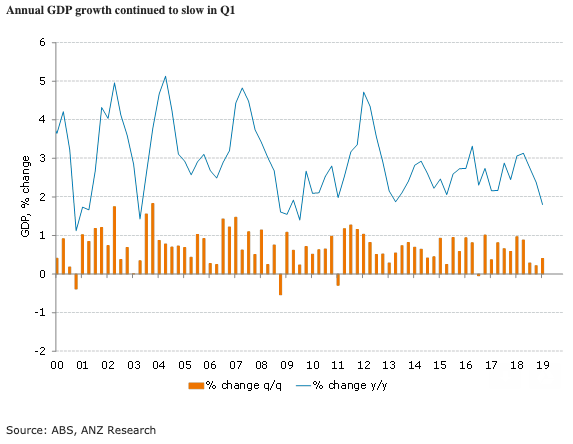
Australia’s gross domestic product (GDP) for the first quarter of this year picked up a little in Q1 to 0.4 percent q/q, although annual growth continued to slow and is now down to 1.8 percent, its slowest pace since 2009 in the midst of the global financial crisis.
Growth continues to be held down by a weak household sector, although business investment and exports are hardly strong. The public sector is certainly doing its bit to support growth, contributing 1.3ppt to the 1.8 percent growth over the past year.
The result looks to be less than the average 0.6-0.7 percent q/q growth the RBA had expected for Q1 and Q2, and suggests that another round of growth downgrades are likely in the Bank’s August Statement on Monetary Policy.
The report shows that weakness in the economy has become more broad-based, and the supports to growth more narrow.
The household sector remains under pressure, with weak income growth and falling house prices weighing on both consumer spending (+0.3 percent q/q) and housing construction (-2.5 percent q/q).
Interestingly, household consumption growth was strongest in NSW and Victoria where house price declines have been the largest, suggesting that income growth is the main driver of weakness.
"The weak tone to GDP confirms the dovish stance taken by RBA Governor, Phil Lowe, but the Bank is likely to be disappointed yet again by these results," ANZ Research commented in its latest report.







