


 RBI Uses $10 Billion Currency Swaps to Drain Excess Rupee Liquidity
  Asian Stocks Fall as Bond Yields Surge Ahead of Trump-Xi Summit
  Australia Unemployment Hits Five-Year High Despite Strong Jobs Growth
  Soybean Futures Slip as Traders Await Trump-Xi Trade Signals
  U.S. Dollar Hits Two-Month High as Oil, Treasury Yields Surge
  Fed Unveils Stablecoin Rules Under GENIUS Act
  European Stocks Fall as Bond Yields and Geopolitical Risks Weigh
  U.S. Treasury Yields Surge as 30-Year Hits 22-Year High


 Add as a preferred source on Google
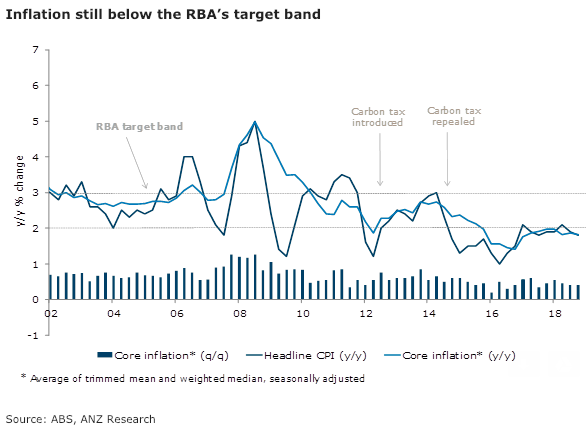
Australia Q4 2018 core inflation came in in line with expectations (market’s and the RBA’s), while headline inflation was slightly stronger than market expectations. The ANZ Diffusion Index was up slightly, indicating that a greater share of the items in the CPI basket are growing at annualised rates greater than 2.5 percent.
Encouragingly, domestic markets service inflation improved to 2.1 percent y/y, suggesting that higher unit labour costs are flowing through to consumer prices. This is important for the inflation outlook, given that the weakness in house prices, rents and secular weakness in retail prices will impede an improvement in inflation.
While the core result was in line with the RBA’s forecast, a lift in core inflation is required in the first half of 2019 to reach the Bank’s June 2019 y/y forecast of 2 percent. This seems a tough ask in light of the loss of economic momentum in the second half of 2018.
Q4 CPI showed a slight improvement in headline inflation which rose 0.5% q/q, although in annual terms it slowed to 1.8 percent (from 1.9 percent in Q3). The largest contributions came from the 9.4 percent increase in tobacco prices and a 6.2 percent lift in domestic airfares. Offsetting this slightly was a 2.5 percent fall in petrol prices.
Core inflation was steady compared to the previous quarter, with both the trimmed mean and weighted median rising by 0.4 percent. This left the annual growth rate (the average of the two measures) steady at 1.8 percent. CPI ex-volatiles (also looked at by the RBA) rose to 0.6 percent q/q, the best result since 2015.
"In a good sign, the ANZ Diffusion Index (which measures the proportion of the basket with annualised price rises of 2.5 percent or more) improved to 39 percent from 37 percent in Q3. This supports our view that the effect from the one-off decrease in administered prices is fading," ANZ Research commented in its latest report.







