


 BTC Flat at $89,300 Despite $1.02B ETF Exodus — Buy the Dip Toward $107K?
  FxWirePro- Major Crypto levels and bias summary


Speculative investors are growing bullish in oil, anticipating an improved supply-demand balance, but it is highly questionable whether this would even be possible in 2016 without some associated cutback in supply. It will definitely take a while for the supply glut to ease, and should it happen, this would be broadly good for global growth prospects, but with some potential risks.
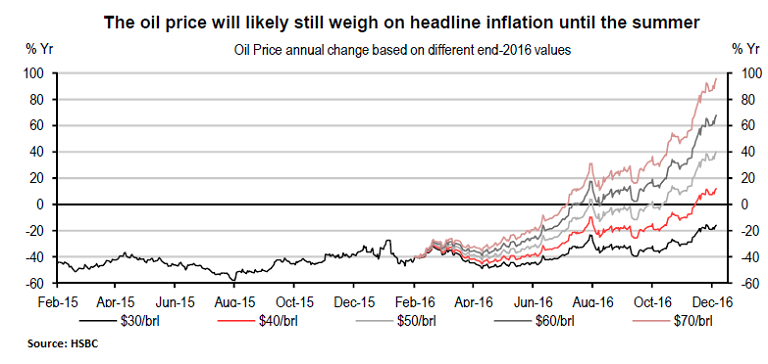
The high degree of correlation of oil prices with all major asset classes suggests that the 36% bounce in crude from the February lows may support global markets after the brutal winter months of January and February. However, the abundance of economic and political threats (China, manufacturing recession, low inflation and UK/EU membership, among other things) will force investors to remain vigilant against abrupt market and liquidity swings.
Oil price rise would lead to a rise in commodity prices, easing the fiscal and financial pressures of commodity-producing economies and thereby easing the pressure on their currency pegs. Non-commodity-producing emerging economies would also likely benefit from stronger export growth. Rising oil prices tend to mean rising overall global demand, rising EM demand and strong EM equity markets.
China's slowdown is of course a headwind, but indications elsewhere are broadly positive. Inflation in the eurozone is still well below target, but growth is holding up, bolstered in part by stimulus measures from the European Central Bank and spending by governments. While European exports will, of course, be affected by declining Chinese demand, they would benefit from stronger exports as external demand (from EM) recovers.
In the eurozone, inflation expectations should stabilise but the high degree of labour market slack likely means that if headline inflation rises, real wage growth would slow and consumer spending will follow. This could raise expectations that the ECB could taper its QE purchases sooner than previously expected. In US and UK economies, where unemployment is at or close to full employment, surge in real wage growth in 2015 helped to keep wage demands at bay. Under this scenario, the Fed would probably continue to raise the funds rate in line with its latest medium-term projections.
In Japan, a meaningful reversal in oil prices could actually force markets to consider the possibility that inflation might approach 2%, especially if it coincides with an acceleration in wage growth (owing to tight labour markets) and, by extension, service price inflation. The BoJ will then have to address the situation of an exit strategy, something which it has refused to discuss earlier.
Brent crude futures hit 8-week high of $37.25 per barrel on Tuesday, up more than $10, or 37.5 percent, from a 12-year low of $27.10 hit in January. U.S. crude futures also hit a one-month high of $34.76 per barrel, but pared gains after API data showed a much bigger build in U.S. crude stockpiles. U.S spot crude prices were trading at 33.67 levels at 1045 GMT.

- News

- Economy

- Central Banks
- Investing
- Research
- Roundups
- Digital Currency
- Insights
- Technical Analysis
- Technology
- Business
- Law
- Health
- Nature
- Fintech
- Science
- Topic
- Opinions
- ©Econometrics LLC . All Rights Reserved.
A demand-driven rise in oil price broadly good for global growth
Wednesday, March 2, 2016 12:04 PM UTC
Editor's Picks









- Market Data
Most Popular




