


 OpenAI Urges US-Led Global Standards for Frontier AI
  Meta Partners With Shopify to Bring Shop Pay Checkout to Muse AI
  Microsoft Stock Upgraded as Stifel Sees Stronger Azure Growth
  Goldman Sachs Names Simon Lyons UK Investment Banking Co-Head
  SoftBank Launches $11 Billion Bond Sale to Fund OpenAI Investment
  SpaceX Nasdaq 100 Weight to More Than Double in Rebalance
  China Vanke Shares Jump as Beijing Moves to Ease Debt Pressure
  FxWirePro- Crypto Weekly Alpha: ETF Rebounds, L2 Rallies & Key Resistance Levels
  Paramount-Warner Bros $110 Billion Deal Draws Antitrust Backlash


 Add as a preferred source on Google





A much-awaited report into Coles and Woolworths has found what many customers have long believed – Australia’s big supermarkets engage in price gouging.
What started as a simple Senate inquiry into grocery prices and supermarket power has delivered a lengthy 195-page-long report spanning supermarket pricing’s impact on customers, food waste, relationships with suppliers, employee wages and conditions, excessive profitability, company mergers and land banking.
The report makes some major recommendations, including giving courts the power to break up anti-competitive businesses, and strengthening the Australian Competition and Consumer Commission (ACCC).
It also recommends making the Food and Grocery Code of Conduct mandatory for supermarket chains. This code governs how they should deal with suppliers. The government’s recent Independent Review of the Food and Grocery Code also recommended making it mandatory for the supermarket giants.
But at this point it’s hard to say what, if anything, the recommendations will mean for everyday Australians and the prices they actually pay.
Price gouging isn’t illegal
At the heart of the Senate inquiry was the question of whether Australian supermarkets were price gouging. According to the committee, the answer is a “resounding yes”, despite the evidence presented by supermarkets to the contrary.
Price gouging is when businesses exploit a lack of competition by setting prices well above cost price. But the practice is not explicitly illegal.

It’s not illegal to set prices higher than they need to be. Denys Kurbatov/Shutterstock
The committee put forward a number of recommendations that could help reduce price gouging. These include making it an offence to charge excess prices and establishing a new “Commission on Prices and Competition” to examine price setting practices in different sectors.
The committee also wants the ACCC to be given enhanced powers to investigate and prosecute unfair trading practices, and to be better funded and resourced.
The committee says supermarket claims that price gouging does not exist should mean the giants have nothing to fear under tougher legislation. However, it says:
the evidence brought forward by people willing to speak out about the business practices of Coles and Woolworths suggests that maintaining margins and increasing margin growth is occurring at the expense of suppliers, consumers, and best business practices, and without proper justification.
It’s unlikely we’ll see relief anytime soon
Will these recommendations actually deliver any relief on prices? It’s hard to say at this point. The recommendations put forward are comprehensive, but they’re unlikely to result in any short-term change for consumers.
At any rate, the Albanese government does not support many of them. In the report’s additional commentary, Labor senators argue that Australian competition law already addresses excessive pricing by prohibiting misleading and deceptive conduct. They also don’t support establishing a new commission to examine prices.
Rather, the report calls for a dramatic overhaul of current regulatory settings, which it says are “not appropriate or fit for purpose”. This is not going to be an easy or fast process.
What does the report mean for the Greens’ divestiture bill?
While the inquiry was underway, the Greens introduced a bill which would give courts “divestiture powers”. This means a corporation could be ordered to sell some of its assets to reduce its market power.
While the bill lacks support from the major parties, the committee suggested that such divestiture powers should be introduced specifically for the supermarket sector. Where abuse of market power was able to be proven, supermarkets could be forced to sell certain stores.
While Australia does not have divestiture powers in this context, some other countries do. In New Zealand, the UK and the US, courts can force corporations that are abusing their market power to sell components of their business. Such powers are very rarely used, but the deterrent they impose can be highly influential on corporate behaviour.
Labor rejects creating any forms of divestiture power in the report’s additional commentary. But the Coalition isn’t entirely against the idea, noting that it “does not believe the committee has persuasively found that divestiture powers should not be pursued at all” and that “divestiture powers should be targeted to sectors of concern”.
What’s next?
At this stage, the report suggests there’s only one action all political parties agree on at this stage: making the Food and Grocery Code of Conduct mandatory and ensuring its full enforcement. We’re unlikely to see much unity on the other recommendations.
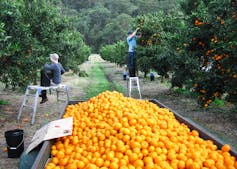
There remains a stubborn power imbalance between major supermarkets and their suppliers. Kevin Wells Photography/Shutterstock
In a scathing commentary, the Coalition argues the report represents “a missed opportunity to address some of the structural imbalances in our supermarket sector that are impacting Australia’s growers, farmers, small businesses, and ultimately consumers”.
While this is a harsh assessment, the reality is that unless these structural imbalances in our food system are addressed, we’re unlikely to see meaningful change.
The report draws on substantial evidence to paint a troubling picture of the food system in Australia – in particular, how growers and consumers are struggling. The task for regulators is working out what mechanisms can be used to address the imbalance of power in the market, in a way that doesn’t force growers or Australian consumers to bear the cost.







