


 How to create a thriving forest, not box-checking ‘tree cover’
  Parasites are ecological dark matter – and they need protecting
  Fertile land for growing vegetables is at risk — but a scientific discovery could turn the tide
  GesiaPlatform Launches Carbon-Neutral Lifestyle App ‘Net Zero Heroes’
  Rise of the Zombie Bugs takes readers on a jaw-dropping tour of the parasite world
  Lake beds are rich environmental records — studying them reveals much about a place’s history
  Burkina Faso and Mali’s fabulous flora: new plant life record released
  We combed through old botanical surveys to track how plants on Australia’s islands are changing
  As the Black Summer megafires neared, people rallied to save wildlife and domestic animals. But it came at a real cost
  Wildfires ignite infection risks, by weakening the body’s immune defences and spreading bugs in smoke
  How is Antarctica melting, exactly? Crucial details are beginning to come into focus
  An unexpected anomaly was found in the Pacific Ocean – and it could be a global time marker
  Swimming in the sweet spot: how marine animals save energy on long journeys
  Fungi are among the planet’s most important organisms — yet they continue to be overlooked in conservation strategies




An ancient kola tree has been cut down in southern Ghana. Local tradition held that the tree had grown on the spot where spiritual leader Komfo Anokye had spat a kola nut onto the ground three centuries previously.
Anokye was a fetish priest – a person believed to act as a mediator between the living and the spirit world – and the tree that took his name was reputedly able to cure ailments and lift curses.
These legends, and its location on a major road, turned the Komfo Anokye tree into a tourist attraction and a symbol of ancestral roots. Its loss is historically, culturally and ecologically significant.
The felling of the iconic tree prompted an outpouring of anger and grief, and a desire to repair the damage done. But what is it about the loss of a tree that provokes such an emotional response? Why is it that single trees are so important to us? And why might our instinct to repair the damage by planting a new tree prove unexpectedly complicated?
One person has been arrested for the action of cutting down the Komfo Anokye Cola tree situated in Feyiase, Bosomtwi. pic.twitter.com/3I0zr1zQxg
— Ghana Crimes (@GhanaCrimes) November 9, 2023
Tree felling as an emotive issue
The felled tree, and the outpouring of emotion that followed, is one of several such high-profile instances. In late October 2023, the decision was made to cut down the 550-year-old Darwin’s Oak in Shrewsbury. The Woodland Trust described the felling as a “death sentence”.
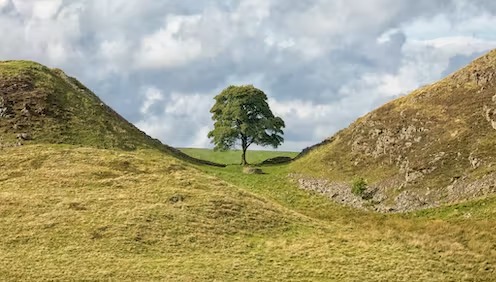
The felling of the Sycamore Gap tree in September 2023, which was located next to Hadrian’s Wall in Northumberland, was described in similarly emotional language.
The deliberate cutting down of trees is highly emotive because they are central to how we perceive ourselves within our environment. Trees are living archives, recording the past of our planet and our own personal histories.
Individual trees are steeped in storytelling and symbolism. Some cultures believe that the spirits of the ancients and family members reside within Africa’s climate-vulnerable baobab. And the Ankerwycke yew at Runnymede in Surrey is described as the last surviving witness to the sealing of the Magna Carta in 1215.
The Sycamore Gap tree was also an iconic image. Its fall prompted local and global reaction on such a scale that we might be forgiven for concluding that felling one tree elicits a more visceral reaction than the destruction of entire rainforests.
While Sycamore Gap was grabbing the headlines, the latest state of nature report showed the UK to be one of the most nature-depleted countries in the world. This juxtaposition exemplifies the different ways in which people ascribe value to nature.
Our research from 2021 explored the different ways that people prioritise their relationships with nature. Some protect nature for human benefit and others seek to protect nature for its own sake. At the same time, some people prioritise the conservation of species and ecosystems, while others focus on the wellbeing of individual specimens.
Iconic trees are a prime example of this contrast. The action we take to protect iconic trees, or to replace those that fall, may satisfy the moral imperative to “do something”. But it is often energised by a greater concern for individual organisms than for the need to protect the wider environment.
Replacing iconic trees
Tree planting has political capital as a way to tackle climate change. But rushing to replace lost nature on our own terms and without effective management can lead to poor outcomes.
Neither a single sapling, nor many, will directly replace the unique ecosystem of a 300-year-old tree – at least not for another 300 years. If we treat nature as easily replaceable, we embrace the “quick fix” and ignore the impact of human actions on ecological succession and the vast complexity of the ecological system.
Ecological succession is the natural and never ending process of change in an ecosystem. It is what allows a healthy woodland to regenerate itself, for example, after forest fires.
Human intervention can disturb this process. The planting of single species or non-native trees can undermine the ecosystem, accelerate soil erosion and increase vulnerability to pests and disease.
The felled tree at Sycamore Gap was removed and stored pending a decision on what to do with it. But, similar acts of removal elsewhere in the wild can disrupt ecosystems too. Dead trees are a vital component of any woodland as they recycle nutrients, support the growth of fungi, and provide a home for a diverse array of birds, insects and mammals.
The tree at Sycamore Gap stood in isolation, but the loss of a single tree is still not without consequence. The complexities inherent in replacing the ecological value of lost trees must not blind us to their wider and equally important cultural significance. In the words of the British-American poet, W.H. Auden: “The trees encountered on a country stroll, reveal a lot about a country’s soul.”
Conservation debates should be about more than economic or functional human benefits. They should integrate history, culture and values into our relationship with the natural world.







