


 Buy the Dip: Gold Holds Strong at $3980, Targets $4150
  Australia Trade Balance Swings to Surprise Deficit as Imports Outpace Exports in May
  Vietnam’s population hit the 100 million milestone. Where’s it headed?
  Oil Prices Steady as U.S.-Iran Peace Talks Ease Strait of Hormuz Supply Fears
  US Resumes Dollar Shipments to Iraq After Months-Long Suspension
  AI can be a personal trainer in your pocket – but is it safe?
  South Korea Warns Won Is Undervalued, Boosts FX Coordination With Japan
  Japan Signals Readiness to Act on Yen as Intervention Speculation Grows
  Michael Burry Shorts Tesla at $416 as AI and Semiconductor Bearish Bets Expand
  Gold Price Holds Above $4,000 as Fed Rate Hike Expectations and U.S. Jobs Data Weigh on Market
  Goldman Sachs Says China Competition Weighs More on EU Growth Than Trade Deficit
  Morgan Stanley Names BAE Systems Top European Defence Stock Despite Lower Price Target
  Asian Currencies Stay Under Pressure as Dollar Holds Near 13-Month High Ahead of U.S. Jobs Report
  State of emergency in Crimea as Ukraine focuses pressure on ‘jewel in Putin’s crown’


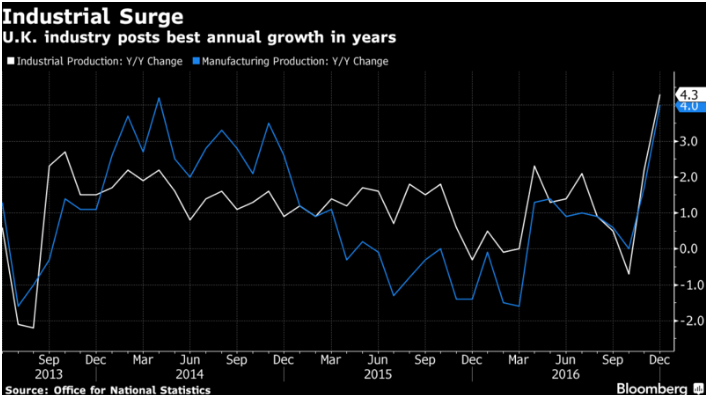
Data released by Office for National Statistics (ONS) showed Friday that U.K. industrial production growth exceeded economists' expectations in December. U.K.'s industrial output climbed 1.1 percent month-on-month in December while manufacturing output expanded 2.1 percent. On a yearly basis, industrial and manufacturing output gained 4.3 percent and 4 percent, respectively.
Both industrial and manufacturing output expanded at a faster pace than economists had forecast. While November’s manufacturing gain had been disproportionately skewed towards an erratic surge in pharmaceutical product output, December’s data showed a more balanced performance. The manufacturing output rise in December was broad-based, with expansion in 9 out of 13 manufacturing sub-sectors.
U.K. manufacturing PMI in December hit its highest level since June 2014. Today's data suggested that the strength seen in surveys is finally being borne out in the ‘hard’ official data, bolstering optimism over the British economy. UK economy is highly reliant on the services sector to drive growth and today's data would give credence to a shift of growth away from the services sector.
"These upside surprises in hard data suggest the possibility of a mild upgrade in Q4 GDP growth estimates to 0.7 percent, from the current read of 0.6 percent. If confirmed, it would likely presage a further round of upward revisions for calendar year growth expectations in 2017 towards the Bank of England’s central view of 2.0 percent." said Lloyds Bank in a report.
Separate data showed Construction output rose 1.8 percent in December after an upwardly revised gain of 0.4 percent m/m in November. The rise was mainly driven by house building and private commercial work, the ONS said. A picture of weakness has also been revised away in the construction sector. The quarterly outturn stood at 0.2 percent q/q.
The pound erased a decline against the euro and dollar following the data. GBP was at 0.8542 against the euro and 1.2447 against the USD at 1215 GMT. Meanwhile, European stocks were trading mixed. London’s FTSE 100 gained 0.34 percent, the Euro Stoxx 50 slipped 0.02 percent, the France's CAC 40 traded up 0.22 percent, while Germany's DAX advanced 0.38 percent.







