


 Meta Unveils Muse Charm AI Device, Expands Smart Glasses Lineup
  Costco Revenue Beats Estimates as Inflation Drives Bulk Shopping
  H&M Q3 Profit Beats Estimates as Margins Improve
  Former OpenAI Data Center Chief Chris Malone Joins Nvidia
  McDonald’s Sees Flat Traffic, Sticky Inflation as New Normal
  Dubai’s connectivity remains strong in an uncertain world
  Novo Nordisk Strikes €1.17 Billion Nanexa Drug Delivery Deal
  EQT Plans €1.7 Billion Sale of Parques Reunidos Stake
  Meta Connect Spotlights Camera-Free Smart Glasses Amid Privacy Concerns
  OpenAI to Preview GPT-6 Cyber AI Model for Cybersecurity
  Oracle Shares Fall as New Mexico AI Data Center Faces Power Delays
  SpaceXAI to Double Nvidia Chips at Colossus 2 by Year-End
  BlackBerry Shares Rise as Q2 Earnings, Revenue Beat Estimates
  Airbus Finds A321neo Fuselage Quality Issue
  US Backs Musk in Fight Against EU’s €120 Million X Fine
  Jeff Bezos Invests $32 Billion in Blue Origin as Space Firm Targets Major Growth
  BMW 2028 Margin Target Could Fall Below Consensus, UBS Says


 Add as a preferred source on Google


From midnight tomorrow, it will become mandatory for anyone in Melbourne and Mitchell Shire leaving their homes to wear a mask. Many people have already been wearing masks for some time in a bid to protect themselves and others from COVID-19.
Evidence has shown masks likely do reduce the spread of COVID-19, so wearing them is a good thing – particularly as Victoria continues to grapple with a second wave.
But one conversation we’re not having enough is around how to safely dispose of single-use masks. Disposing of used masks or gloves incorrectly could risk spreading the infection they’re designed to protect against.
A convenient choice
While reusable cloth masks are an option if you’ve been able to buy one or even make one yourself, disposable, single-use surgical masks appear to be a popular choice. They provide protection and they’re cheap and convenient.
It’s estimated the global use and disposal of masks and gloves will amount to 129 billion face masks and 65 billion plastic gloves for every month of the COVID-19 pandemic.
The effect on the environment is an important but separate issue to the health risks we’re discussing here.
Alarmingly, from what we’ve observed, people are discarding masks in communal rubbish bins and even leaving them in empty shopping trolleys.
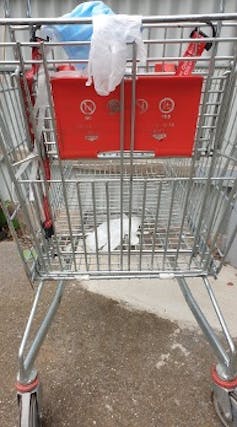
Incorrectly disposing of masks could create a risk of infection for others. Kate Kennedy, Author provided
People should know better than to leave used masks lying around. But they can’t be expected not to discard them in public bins when there’s no other option, and when they’re not given any advice on how to dispose of them properly.
Importantly, while there are clear guidelines on the disposal and separation of medical waste within health-care settings, guidelines for disposal of surgical masks in public settings are unclear.
The Victorian government simply advises they be disposed of “responsibly in the rubbish bin”, meaning they will be mixed with ordinary waste. This is in contrast to personal protective equipment (PPE) used in health-care settings, which is disposed of separately to regular waste, transported to sealed landfill, and in some cases incinerated.
Why could this be a danger?
We don’t yet know a whole lot about the survival of SARS-CoV-2, the coronavirus that causes COVID-19, on textile materials.
One study published in the medical journal The Lancet found no infectious SARS-CoV-2 could be detected on textile materials after 48 hours.
A review study which looked at the survival of a range of pathogens on textiles found viruses could survive longer than 48 hours, though not as long as bacteria.
Although we need more research on this topic, it seems there is potential for cross-contamination, and therefore possibly COVID-19 infection, from disposed masks.
In all likelihood, other people, such as supermarket staff collecting trolleys, or waste handlers, will come into contact with discarded masks well within that 48 hour window.
In addition, if the discarded mask is carrying infectious particles, it may be possible for these to cross-contaminate the surfaces they come into contact with, such as shopping trolleys. And we know SARS-CoV-2 survives more readily on hard surfaces than porous ones, so this is a worry.
Who needs to act?
This issue is a potential biosecurity concern, and we need segregation of used masks from ordinary waste immediately. We urge attention from the Victorian government and local councils to act on this issue, including in the following ways:
-
create general awareness of this problem, potentially by including messaging around how to properly dispose of masks in directives on their use
-
install pop-up secured bins in public places such as shopping centres for used masks and gloves
-
workers collecting the waste should follow biohazard protocols similar to those used to manage waste collected from health-care settings.
What you can do
In the first instance, please don’t leave your used masks and gloves in a shopping trolley, or lying around anywhere else.
The safest thing to do is to put used masks and gloves into a plastic bag when you take them off, and seal it. Then, when you’re back at home, throw the bag away into a closed bin.
Hopefully we will have further directions on how to dispose of these items soon.







