


 AI is supercharging money scams – here’s what you can do to protect yourself
  fnny Beta Launches With a Simple Idea: Find an Event, Show Up, Get Rewarded
  Hawkish Fed Fuels Gold Sell-off: Gold Dives Below $4300 Amidst Rate Hike Fears
  Europe can’t achieve space sovereignty alone. Here’s why
  Gold Slides to $4,262 as Hawkish Fed Rate Hike Triggers Technical Breakdown
  Who should own the knowledge that underpins AI technology?
  What is Zionism? The different meanings of a contested term
  Big AI wants to slow down AI research. Is it a safety pause or a strategic retreat?
  Physicists zoom into the birth of cosmic rainstorms with new CERN study
  FxWirePro- Crypto Weekly Alpha: ETF Rebounds, L2 Rallies & Key Resistance Levels


 Add as a preferred source on Google
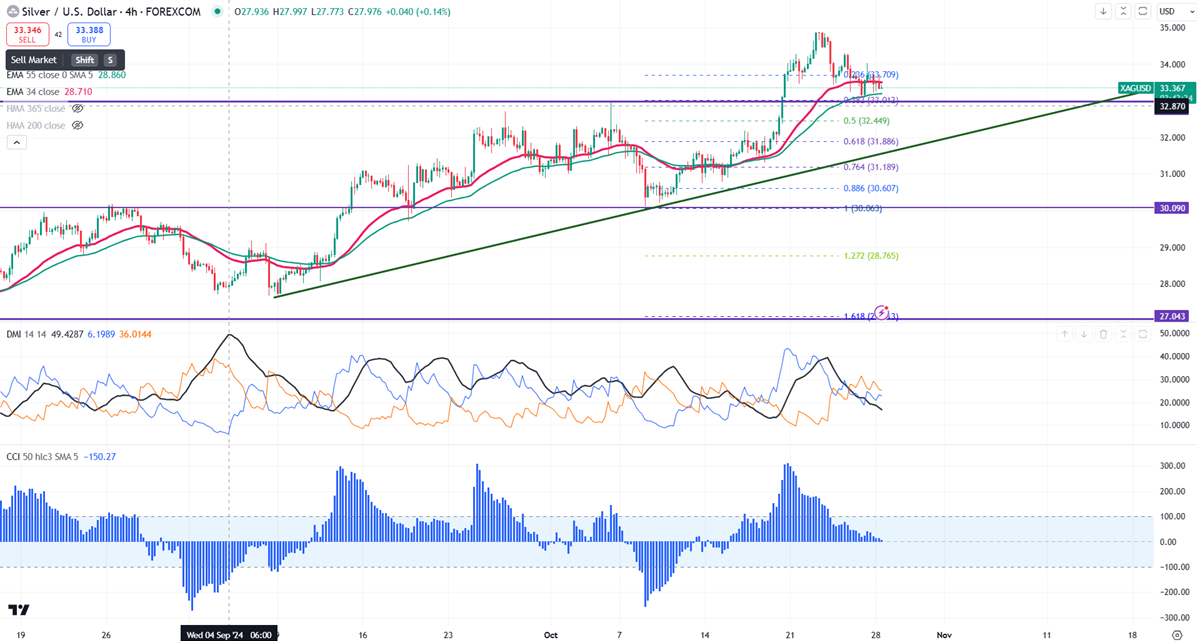
Silver lost its shine on strong US dollar and rising U.S. Treasury yields. It reached a low of $33.09 and is currently trading around $33.19. The short-term trend remains positive as long as support at $31.85 holds.
Silver is increasingly in demand due to its important role in solar technology, especially with the global focus on renewable energy. It is a key material used in photovoltaic (PV) cells for solar panels, typically requiring about 20 grams of silver per panel. Silver's high electrical conductivity helps solar panels convert sunlight into electricity efficiently. This makes silver crucial for improving solar energy production.
Recent strong economic reports from the U.S. have created a mixed view on the chances of significant interest rate cuts by the Federal Reserve. While some rate reductions are expected, the economy's strong performance could slow down how quickly and how much these cuts happen.
The gold-silver ratio is at 81.77, indicating that gold has outperformed silver recently. A ratio above 80 might suggest that silver could be a more appealing investment compared to gold.
For trading, the major level to watch is $34.50. Silver is currently above key moving averages, with near-term support at $33. If it drops below this, it could target $32.70, $32.40, or $32. On the upside, immediate resistance is at $33.70, and breaking this could lead to targets of $34.50/$34.73, $35, or $36.
It may be a good strategy to buy on dips around $33, with a stop-loss at $32 and a target price of $35.







