


 U.S. Stock Futures Slide as Tech Rout Deepens on Amazon Capex Shock
  Singapore Budget 2026 Set for Fiscal Prudence as Growth Remains Resilient
  How to create a thriving forest, not box-checking ‘tree cover’
  LA fires: Fast wildfires are more destructive and harder to contain
  How ongoing deforestation is rooted in colonialism and its management practices
  Burkina Faso and Mali’s fabulous flora: new plant life record released
  South Africa Eyes ECB Repo Lines as Inflation Eases and Rate Cuts Loom
  Japan Economy Poised for Q4 2025 Growth as Investment and Consumption Hold Firm
  RBI Holds Repo Rate at 5.25% as India’s Growth Outlook Strengthens After U.S. Trade Deal
  Thousands of satellites are due to burn up in the atmosphere every year – damaging the ozone layer and changing the climate
  The UK is surprisingly short of water – but more reservoirs aren’t the answer
  Gold and Silver Prices Rebound After Volatile Week Triggered by Fed Nomination
  Gold Prices Slide Below $5,000 as Strong Dollar and Central Bank Outlook Weigh on Metals
  Oil Prices Slide on US-Iran Talks, Dollar Strength and Profit-Taking Pressure
  Drug pollution in water is making salmon take more risks – new research
  Fungi are among the planet’s most important organisms — yet they continue to be overlooked in conservation strategies


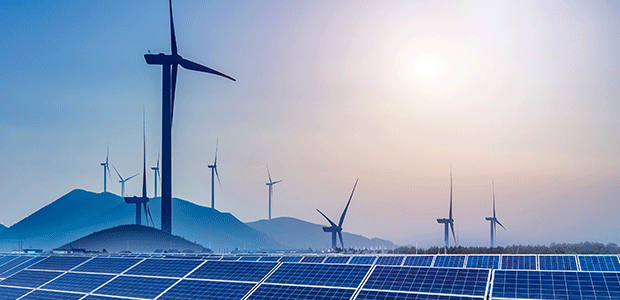
Greenflation” or price hikes in renewable technology resources such as metals, minerals, and others is becoming a concern due to surging energy prices and the government's finalized plan to drastically cut greenhouse gas emissions.
According to industry sources, South Korea "has plenty of reasons to be nervous" about soaring utility costs.
On Monday, the US West Texas Intermediate (WTI) Crude Futures reached a seven-year high of $83.73 per barrel while Brent Crude oil hit a three-year high price of $86.04 per barrel.
With China struggling with its energy supply and other key economies rebounding from the pandemic facing higher energy demand, the shortages of natural gas and coal are in full view.
South Korea’s new goal of cutting greenhouse gas emissions has increased by 40 percent by 2030 from 2018 levels.
The new goal would require manufacturing businesses to drastically overhaul their facilities coal and liquefied natural gas account for 60 percent of their energy supply.
It costs 276 won per kilowatt-hour to generate electricity from a 20-gigawatt floating offshore wind farm to be built by South Korea by 2034--five times more than the cost of generating electricity through nuclear power plants, which the Moon government seeks to phase out.
Consequently, the Federation of Korean Industries (FKI) has been against the government's plan.
They argued that the government is "not being sufficiently cautious" in its green campaign implementation and "not considerate" about the difficulties faced by enterprises in the carbon neutrality transition.
Incheon National University professor Son Yang-hoon said that greenflation’s effects would possibly be "felt across every corner of society, including households."
Son added that greenflation may be passed on to future generations if not properly addressed.













