


 Gold Loses Momentum as Yields Rise and Safe-Haven Demand Fades
  ‘Vibe coding’ is fun and easy, but there’s a major catch
  Standard Chartered Beats Profit Forecasts as First-Half Earnings Rise 9%
  Barclays Q2 Profit Beats Forecasts as Investment Banking Strength Offsets Higher Costs
  SK Hynix Q2 Profit Hits Record as AI Memory Chip Demand Fuels Growth
  SpaceX Wins $1.6 Billion U.S. Space Force Launch Contracts for Falcon 9 Missions Through 2027
  BHP, Port Hedland Unions Fail to Reach Wage Deal as Negotiations Continue
  Exosens H1 Profit Beats Forecasts as Defense Demand Drives Growth
  Meta CEO Zuckerberg Opposes U.S. Ban on Chinese AI Models, Warns Against Overregulation
  TSMC Gradually Restarts Japan Chip Plant After Kumamoto Earthquake
  Starbucks Stock Jumps as Q3 Earnings Beat, Sales Growth Drives Higher 2026 Outlook
  Samsung Q2 Profit Surges on AI Memory Chip Demand, Forecasts Strong Second Half
  Microsoft Stock Jumps as Azure Growth, AI Revenue Beat Expectations
  Morgan Stanley Downgrades Adobe, Workday as AI Transition Raises Growth Concerns
  Is Netanyahu’s star waning in Washington? His latest meeting with Trump suggests it may be


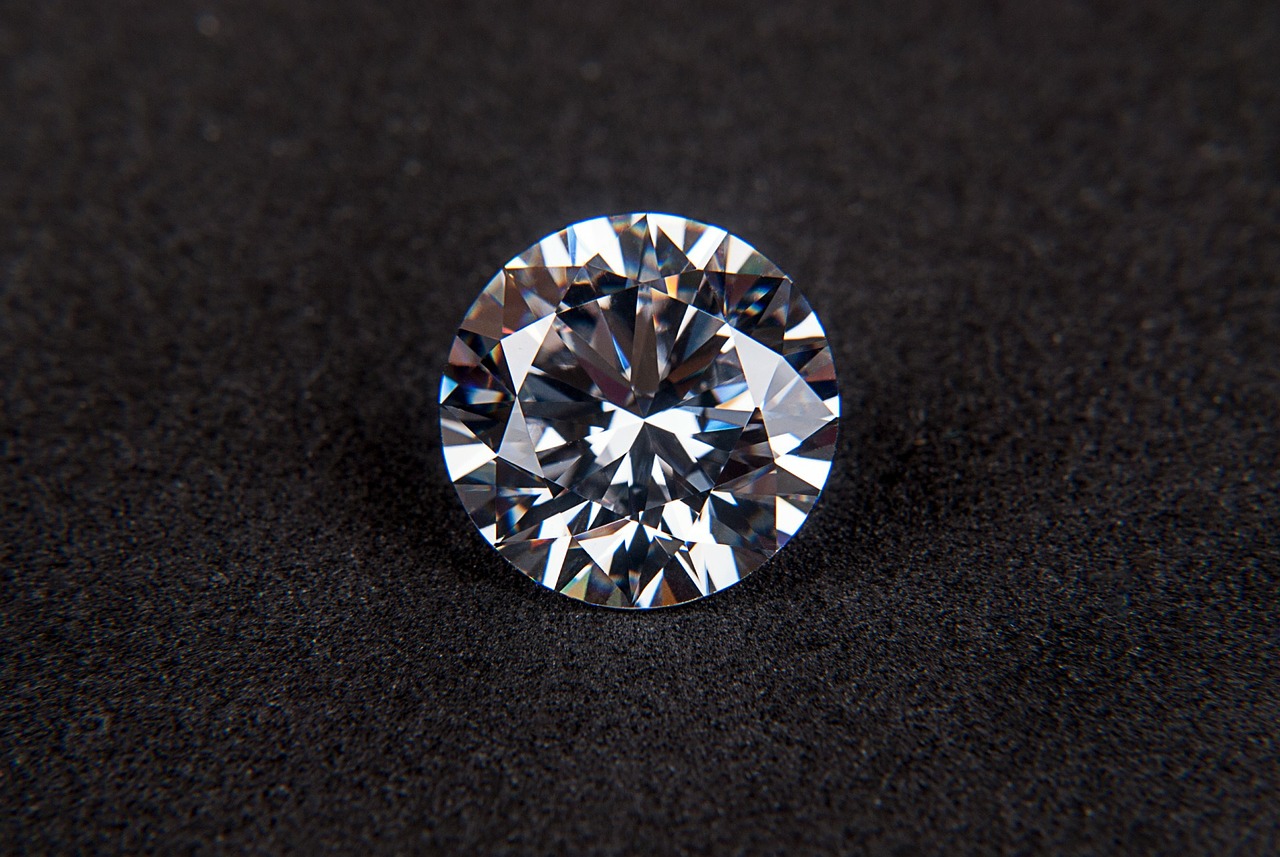

You’ve probably heard the saying “a diamond is forever”. What if the market for them – with its hefty price tags – isn’t?
Back in March, Rio Tinto ended production at its Diavik diamond mine in Canada after 23 years. Earlier this month, diamond mining company De Beers announced a two-year production pause at the company’s flagship Venetia mine in South Africa.
De Beers is majority-owned by global mining giant Anglo American. According to a Bloomberg report this week, Anglo is now in talks to sell its 85% stake for about US$1 billion – a tiny fraction of the US$18 billion it was valued at when taken private in 2001.
So, what’s going on? The industry certainly hasn’t run out of diamonds to mine. But current prices and costs have made continued production of natural diamonds harder to justify.
Over the past couple of decades, lab-grown diamonds have changed the game. Consumers are also reconsidering what makes a diamond valuable – and what responsible consumption means.
A lesson from aluminium
In the mid-nineteenth century, aluminium was treated as a luxury material and its value exceeded that of gold. While it was abundant in the Earth’s crust, it was difficult and expensive to isolate and refine.
This dynamic shifted in the latter half of the century, when new industrial processes made aluminium far cheaper to produce at scale.
Our calculations show an ounce of aluminium that sold for around US$34 in 1852, equivalent to approximately US$1,475 today, now trades for less than ten US cents.
Diamonds are not aluminium, of course; they also carry stories about love, status, memory and commitment.
Still, the comparison is useful, as the development of lab-grown diamonds has begun to weaken the connection between scarcity and price.

Aluminium has gone from expensive, precious metal to the basis of many everyday products. Julia Maior/Unsplash
How diamonds came to mean so much
Objects do not possess value in any absolute sense. Diamonds, like gold, paintings and luxury handbags, are valuable, in large part, because consumers attach importance to characteristics such as scarcity, history, status and cultural meaning, not simply because of their physical properties.
A diamond’s price has never depended only on its hardness, sparkle or chemical composition. It has also depended on what people believe those qualities represent.
The slogan “a diamond is forever”, coined for De Beers by an advertising agency in 1947, helped connect diamonds with permanent love in the minds of consumers. Over time, the price itself became part of the message.
Spending heavily on an engagement ring could be read as evidence of seriousness, sacrifice and devotion. This worked while several things remained bundled together.
A diamond looked distinctive, came from the ground, appeared scarce and carried a high price. Lab-grown diamonds are now separating those elements.
What lab-grown diamonds changed
Lab-grown diamonds are not imitations. They have essentially the same chemical and physical properties as natural diamonds and are difficult to distinguish without specialist equipment. Buyers can choose a larger and clearer stone for less money and use the difference for housing, travel or the wedding itself.
A recent survey of more than 10,000 US couples by wedding planning brand The Knot found 61% of those married in 2025 had chosen a lab-grown centre stone for their engagement ring.
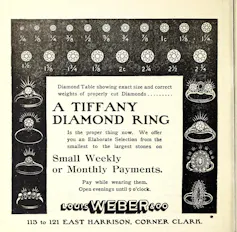
A 1902 advertisement for diamond rings for sale by Louis Weber & Co, in Chicago, Illinois. Public domain, via Wikimedia Commons
Some consumers also associate lab-grown diamonds with avoiding the environmental and social problems linked to mining.
Beyond offering a cheaper option, lab-grown diamonds are also forcing consumers to decide which parts of the traditional diamond story matter to them. Is it the appearance, natural origin, rarity, price or meaning attached to the purchase?
Why natural diamond prices are falling
Lab-grown diamonds are a major part of the story, especially in the US engagement-ring market, but they are not the only factor.
The natural-diamond industry is also facing weak demand in China, cautious luxury spending, high inventories after the pandemic, and geopolitical and tariff disruption.
In its production report for the first quarter of 2026, De Beers reported that its average realised rough-diamond price fell 19%.
However, the pressure is uneven. Smaller and more standardised natural diamonds compete directly with cheaper lab-grown stones. Larger, unusual or higher-quality natural diamonds have more scope to justify their price through rarity, provenance and craftsmanship.
A market in transition
It is tempting to frame the natural diamond story as a simple lab-grown victory. A more cautious reading is that the market may be separating, at least for now.
Lab-grown stones compete on affordability, size and design flexibility, while natural diamonds may rely more heavily on rarity, their history and origin story.
Whether this becomes a stable long-term structure remains unclear. Continued falls in lab-grown prices and changing consumer preferences may place further pressure on more standardised natural diamonds.
Reducing mine output may support prices, but it cannot by itself restore demand. Producers will still need to explain why geological origin remains worth paying for.
The effects extend beyond jewellery retailers. Weaker demand can affect workers, mining communities and diamond-dependent economies, such as Botswana, where diamonds account for around 80% of exports and about one-third of government revenue.
At the same time, diamond mining has been linked to worker exploitation and environmental degradation. Responsible consumption therefore involves considering who benefits, who bears the costs and how credible the claims made on both sides are.
The question is no longer simply whether consumers want diamonds, but what they believe they are paying for.

The authors do not work for, consult, own shares in or receive funding from any company or organisation that would benefit from this article, and have disclosed no relevant affiliations beyond their academic appointment.









