


 SK Hynix Targets $29.4 Billion Nasdaq Listing to Expand AI Chip Business
  Samsung Electronics Stock Surges on Report of Massive $59 Billion Share Buyback Plan
  Gold's 365-Day EMA Streak Since Oct 2023 Faces Its First Real Test at $3,980 — Break or Bounce to $4,140?
  DOJ Opens Investigation Into NYC Coffee Shop Over Anti-Goldman Social Media Post
  Tencent Reviews Marvelous Stake as Gaming Giant Reassesses Global Investment Strategy
  Fortescue Faces Class Action Over Sexual Harassment Claims at Australian Mining Sites
  Baseten Secures $1.5 Billion Funding at $13 Billion Valuation Amid AI Infrastructure Boom
  SK Hynix Moves Closer to New York ADR Listing Amid AI Chip Boom
  Tesla and NatPower Partner on $5 Billion Battery Storage Expansion in Europe
  Kioxia Targets U.S. Listing as AI Chip Boom Accelerates
  Nissan Halts Electric Qashqai Development Amid EV Market Challenges
  Trump Orders DOJ Investigation Into Exxon, Chevron Over High Gas Prices
  Heineken Names JDE Peet’s CEO Rafael Oliveira as New Chief Executive
  AI Memory Boom Sparks Global Chip Supply Crunch


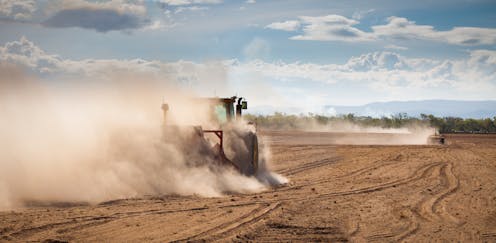

Three-quarters of Earth’s land has become drier since 1990.
Droughts come and go – more often and more extreme with the incessant rise of greenhouse gas emissions over the last three decades – but burning fossil fuels is transforming our blue planet. A new report from scientists convened by the United Nations found that an area as large as India has become arid, and it’s probably permanent.
A transition from humid to dry land is underway that has shrunk the area available to grow food, costing Africa 12% of its GDP and depleting our natural buffer to rising temperatures. We have covered several consequences of humanity’s fossil fuel addiction in this newsletter. Today we turn to the loss of life-giving moisture – what is driving it, and what we are ultimately losing.

Why is the land drying out so fast? It’s partly because there is more heat trapped in the atmosphere by greenhouse gases emitted from burning fossil fuels. This excess heat has exacerbated evaporation and is drawing more moisture out of soil.
‘Oil, not soil’
Climate change has also made the weather more volatile. When drought does cede to rain, more of it arrives in bruising downpours that slough the topsoil.
A stable climate would deliver a year’s rain more evenly and gently, nourishing the soil so that it can nurture microbes that hold onto water and release nutrients.
This is the kind of soil that industrial civilisation inherited. It’s disappearing.
“Soil is being lost up to 100 times faster than it is formed, and desertification is growing year on year,” says Anna Krzywoszynska, a sustainable food expert at the University of Sheffield.
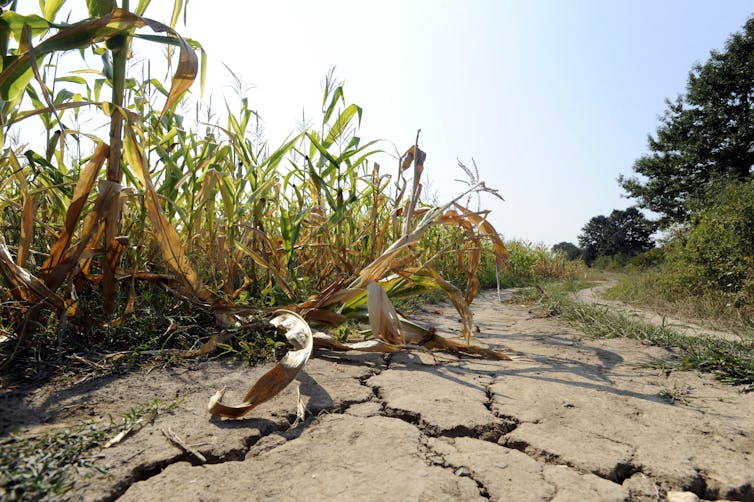
Humid and fertile farmland is becoming increasingly arid. Nikola Fific/Shutterstock
“The truth is, the modern farming system is based around oil, not soil.”
Fossil fuels have unleashed agriculture from the constraints of local ecology. Once, the nutrients that were taken from the soil in the form of food had to be replaced using organic waste, Krzywoszynska says. Synthetic nitrogen fertilisers, made with fossil energy at great cost to the climate, changed all that.
Next came diesel-powered machinery that brought more wilderness into cultivation. Farm vehicles as heavy as the biggest dinosaurs now churn and compact the soil, making it difficult for earthworms and assorted soil organisms to maintain it.
Tractors and chemicals served humanity for a long time, Krzywoszynska says. But soil is now so degraded that no amount of fossil help can compensate.
“Across the world, soils have been pushed beyond their capacity to recover, and humanity’s ability to feed itself is now in danger.”
Green pumps and white mirrors
The primary way that we have been making up for lost food yield is turning more forests into farms. This is accelerating our journey towards a drier, less liveable world because forests, if allowed to thrive, create their own rain.
“Water sucked up by tree roots is pumped back into the atmosphere where it forms clouds which eventually release the water as rain to be reabsorbed by trees,” say Callum Smith, Dominick Spracklen and Jess Baker, a team of biologists at the University of Leeds who study the Amazon rainforest.
“In the Amazon and Congo river basins, somewhere between a quarter and a half of all rainfall comes from moisture pumped from the forest itself.”
Some experts have argued that the UN report understates Earth’s growing aridity by overlooking the water that is held in snow caps, ice sheets and glaciers. Climate change is melting this frozen reservoir, which also serves as a seasonal source of water.
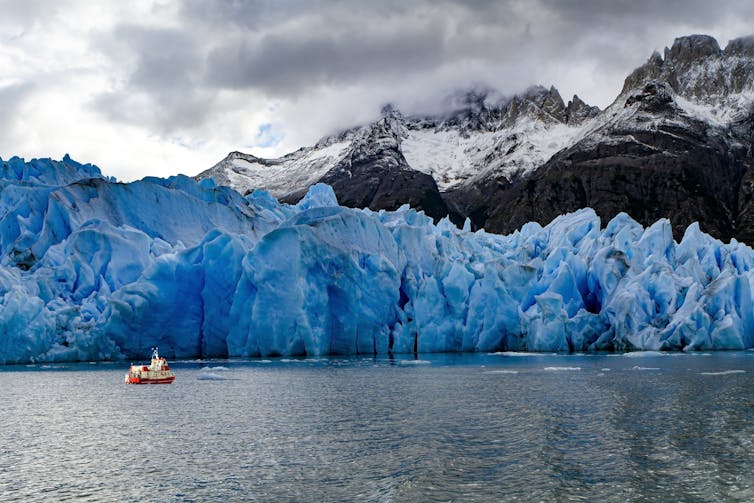
Rising temperatures are depleting stores of freshwater, including glaciers. Kavram/Shutterstock
“And as water in its bright-white solid form is much more effective at reflecting heat from the sun, its rapid loss is also accelerating global heating,” says Mark Brandon, a professor of polar oceanography at The Open University.
How do we adapt our relationship with the land to remoisturise the world? Krzywoszynska argues that there is no easy solution, but the future of food-growing “is localised and diverse”.
“To ensure that we eat well and live well in the future, we’ll need to reverse the trend towards greater homogenisation which drove food systems so far.”
The good news, according to Krzywoszynska, is that farmers are experimenting with methods that restore the soil even as they produce a diverse range of nutritious food. These innovators need rights and secure access to the land, the opportunity to share their experiences and financial and political support.
“Regenerating land is a win-win, for humans and their ecosystems, if we dare to look beyond the immediate short-term horizon,” she says.







