


 Japan Signals Surprise Yen Intervention Strategy as BOJ Hawkish Stance Puts FX Traders on Alert
  Buy the Dip: Gold Holds Strong at $3980, Targets $4150
  BOJ Rate Hike Expected to Boost Yen, Impact USD/JPY and Nikkei
  BoE Policymaker Alan Taylor Signals No Need for Interest Rate Hike Amid Iran War Inflation Risks
  Best Gold Stocks to Buy Now: AABB, GOLD, GDX
  Gold Prices Fall Amid Rate Jitters; Copper Steady as China Stimulus Eyed
  Vietnam’s population hit the 100 million milestone. Where’s it headed?
  AI can be a personal trainer in your pocket – but is it safe?
  FxWirePro: Daily Commodity Tracker - 21st March, 2022


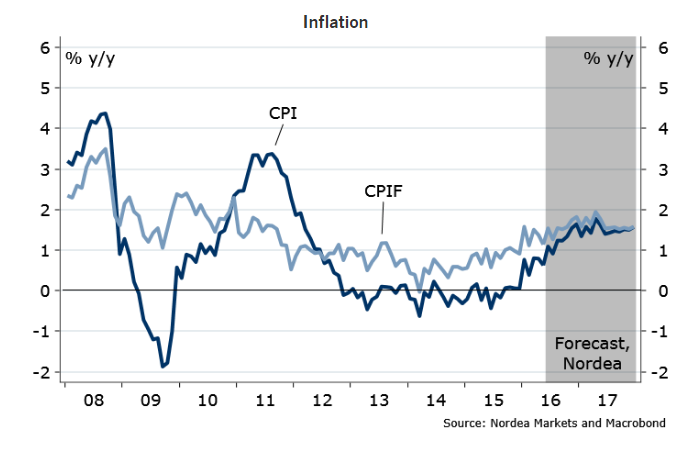
Swedish inflation slowed more than estimated in May. The inflation rate according to CPIF was 1.1 percent y/y in May 2016, as compared to the previous month’s 1.4 percent and consensus expectations of 1.2 percent. After four years mainly spent below 1%, the Swedish CPIF bounced sharply to 1.5% at the beginning of the year, taking a step towards the Riksbank's 2% inflation target.
The Riksbank made clear that policy needs to continue to be expansionary to safeguard the rising trend in prices to prevent an excessively fast SEK appreciation. But with the main rate already at -50bp (at only a step from the implicit floor set in Switzerland at -75bp) and inflation expected to stabilise around 2% next year, new cuts are probably ruled out by the board.
"We do not expect the Riksbank to raise rates over the forecast horizon or household borrowing costs to rise markedly for other reasons. Nor is further regulation, such as a debt ceiling or a phase-out of interest relief, likely over the forecast horizon through December 2017," said Nordea Bank in a report.
Uncertainty after the UK referendum on the future of the EU/UK seems here to stay. The short-term effects on the Swedish economy should be relatively small. The housing market will become an important theme in financial markets, affecting both the krona and interest rates. Domestic demand has been the key driver of growth in the Swedish economy in recent years. The domestic economy has been fuelled by lower interest rates; this has created a positive spiral with rising home prices, accelerating wealth and a pick-up in spending and employment. At present, there are no factors likely to trigger a collapse in home prices.
Over the past two years, better global conditions have improved Swedish exports, mainly via increased exports of services. Short term uncertainties exist, but over the forecast period, international demand is set to rise and pave the way for some growth in exports. With its 4.2% y/y Q1 GDP growth largely beating the European average, Sweden does not have serious competitors among developed countries. EUR/SEK was trading at 9.4241, while USD/SEK was at 8.4852 at 1220 GMT.







