


 Xiaomi Shares Jump on Europe EV Expansion Plan
  ByteDance Secures $29.6 Billion Loan to Boost AI Investment
  Milei Threatens Falkland Oil Firms With Sanctions
  GSM Eyes US, Europe Expansion Ahead of 2028 Hong Kong IPO
  Berkshire Hathaway Eyes Bigger Stakes in Japan’s Top Trading Houses
  CATL Shares Fall as Hungary Plant Faces Safety Halt
  Lynas Rare Earths Shares Rise After Takeover Talks Revealed
  Thomson Reuters C-Track Cyberattack Hits Courts Across U.S. and Canada
  Audi, SAIC Launch China Innovation Hub for New AUDI Models
  Lenovo Shares Fall After Dropbox Security Breach Exposes ID Vulnerability
  Nvidia Eyes $2.5 Billion Investment in Thinking Machines Lab
  MongoDB Stock Sinks 14% as Atlas Growth Misses Expectations
  Tesla Cybercab Rides Launch in Austin as NHTSA Reviews Rollout
  Qantas Near-Miss Raises Sydney Air Traffic Controller Fatigue Concerns
  Shein Shares Drop 5% After Weak Hong Kong IPO Debut
  Adobe Names Anil Chakravarthy CEO as AI Push Accelerates
  Microsoft to Reveal Azure Revenue in Major Reporting Shake-Up


 Add as a preferred source on Google


If you’ve ever watched Game of Thrones, The Fall, or Line of Duty, you’ve already witnessed Northern Ireland’s growing role in the global film and TV industry. But its popularity as a location for film shoots is only one part of a growing role within the creative industries sector.
The launch of a £72 million film-making complex in Belfast this year, Studio Ulster, is another big step towards the region’s aim to become a creative industries hub. The new studios will offer virtual production, alongside traditional facilities for film, animation, video games and broadcasting.
The idea is to give an extra boost to the burgeoning Northern Irish film and TV industry, which has already contributed £330 million to the region’s economy over the past five years. Studio Ulster is part of a £50 billion expansion plan which aims to make Northern Ireland a modern hub of creative industries for local, regional and international co-productions.
So, could modern day creatives replace the shipbuilders that made Belfast the home of ocean liners in the early 20th century?
Virtual production
Developed by Ulster University in partnership with Belfast Harbour and Northern Ireland Screen, Studio Ulster boasts of links with higher education institutions and regional industry partners. It promises to use research, education and economic growth to create much needed new jobs while transforming Northern Ireland into a pinnacle of modern film-making.
The studio is being billed primarily as a virtual production studio, offering a relatively new way of film-making that combines virtual and real-world elements. It will specialise in CGI, augmented reality and motion capture.
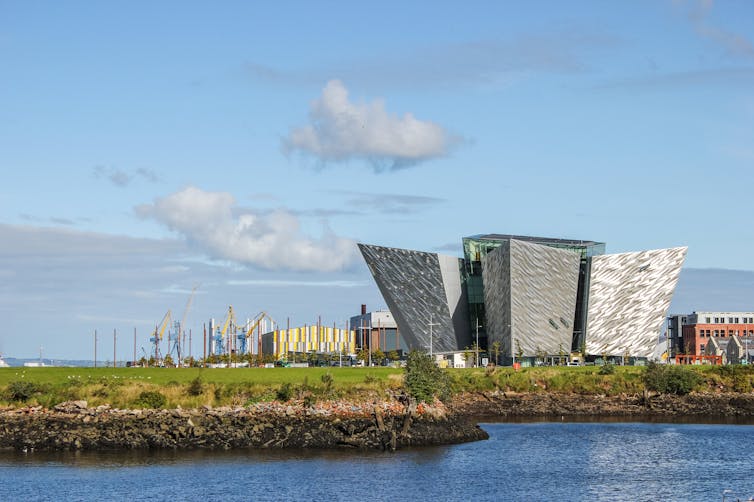
Belfast’s Titanic Museum commemorates the city’s role as a shipbuilding hub. It’s also home to Titanic Studios, pictured here behind the museum. OldskoolDesign/Shutterstock
But relying so heavily on virtual production could be a risky move. Investing in new technologies brings great potential for success but also for failure. It’s always difficult to predict which way a new technology will go.
Virtual production is complex – in its current stage of development – not without flaws and limitations. For example, although the integration of the LED panel backgrounds and studio environment allows for unlimited types of environments, it restricts the scope for filming movement. In other words, actors can’t walk long distances in one shot without a cut, which can be frustrating for film-makers.
The emergence and rapid development of AI could also see virtual production replaced with an entirely new technology, making such expensive facilities unnecessary. There is always a danger that it could become another cinematic misstep – like 3D cinema.

Locations like the Dark Hedges in Country Antrim already attract tourists and filmmakers alike to NI. Dawid K Photography/Shutterstock
Then there is the risk of an expensive new studio just not being used enough. Studio Ulster needs to avoid meeting the same fate as the City of Lights, a state-of-the-art film studio in Alicante, Spain, that was subsequently abandoned.
Once the most modern film studio in Europe, it was praised by the Hollywood director Ridley Scott, and hosted Game of Thrones and Black Mirror productions before it was forced to shut by the EU on grounds of unfair competition. A decade later, the owners now hope to reopen it, but after all this time, it will not be the brand new modern studio it once was.
Another Titanic?
But it’s not all about the facilities and the technology. The human talent – the producers, the camera operators, the editors, the lighting experts – have already been hard at work in Northern Ireland. Hopefully, with the latest project’s educational and research links, and planned international collaborations, they will remain, bringing optimism and job opportunities.
With the Irish film industry booming – the short film An Irish Goodbye won an Oscar in 2022 – Studio Ulster will be hoping to build on this momentum to cement the status of the film industry in this part of the world.
It certainly has a bold vision. As well as turning Northern Ireland into a promised land for contemporary film-making, it wants to boost the economy, enrich lives and strengthen the UK’s global image as a film and television hub.
But relying on virtual production could turn out to be a gamble. We’ll have to wait and see whether the project becomes a heart-warming economic success story – or end up as an expensive and ill-fated launch that reminds locals of the most famous of Belfast-built ships, the Titanic.







