Elon Musk’s Empire: SpaceX, Tesla, and xAI Merger Talks Spark Investor Debate
  Court Allows Expert Testimony Linking Johnson & Johnson Talc Products to Ovarian Cancer
  Federal Judge Restores Funding for Gateway Rail Tunnel Project
  Newly Released DOJ Epstein Files Expose High-Profile Connections Across Politics and Business
  Trump Administration Sued Over Suspension of Critical Hudson River Tunnel Funding
  CK Hutchison Launches Arbitration After Panama Court Revokes Canal Port Licences
  Federal Judge Blocks Trump Administration Move to End TPS for Haitian Immigrants
  Trump Family Files $10 Billion Lawsuit Over IRS Tax Disclosure
  Google Halts UK YouTube TV Measurement Service After Legal Action
  BTC Flat at $89,300 Despite $1.02B ETF Exodus — Buy the Dip Toward $107K?



The world generated 242 million tonnes of plastic waste in 2016 – a figure that’s expected to grow by 70% in the next 30 years. But this same plastic is also a commodity that’s sold and traded in a global industry that generates US$200 billion every year.
Exporting plastic waste is one way rich countries dispose of their waste. By selling waste to firms that then send it to countries where recycling costs are cheaper, rich countries can avoid the unpleasant task of finding somewhere at home to dispose of it. Unfortunately, most of this waste is shipped to countries that aren’t equipped to properly manage it.
When wealthy countries export their plastic waste to poorer countries with weaker recycling capacity, those plastics are often dumped, eventually polluting the land and sea. But a recent UN decision could help those countries most affected by plastic litter and with the least capacity to manage it. Due to a little-known treaty called the Basel Convention, poorer countries can now say no to the deluge of exported waste.
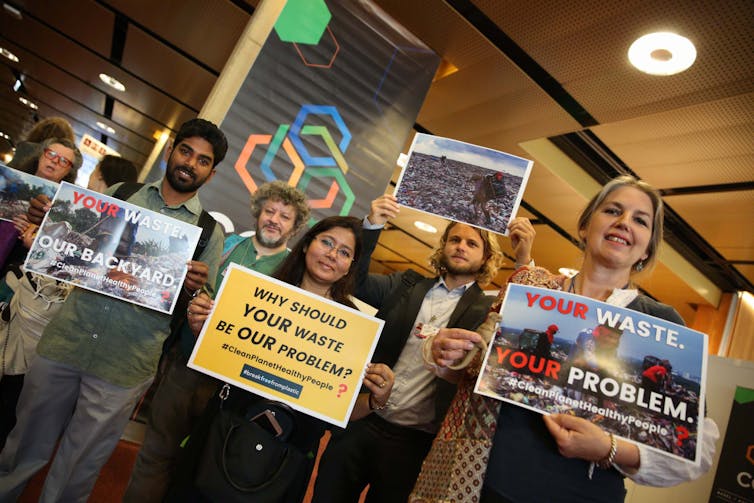
Activists urge progress at the Basel Convention. IISD/ENB | Kiara Worth, Author provided
An enduring injustice
The Basel Convention was adopted by the UN in 1989 to manage the flow of toxic waste sent from rich to poor countries. It’s cheaper for wealthy countries to relocate their waste to areas with lower costs and oversight, and so opportunities to abuse the system emerge.
Italian waste management firms made headlines in 1988 because they stored hazardous wastes in a Nigerian fishing village, in drums labelled as building materials. For years Canada delayed repatriating waste – including nappies – dumped by a Canadian firm in the Philippines. The refuse has been sitting in the sun there since 2013.
The images of plastic waste piling up on beaches in many developing countries, including on some of the world’s most remote islands, prompted an effort led by Norway to use the Basel Convention for its original purpose.
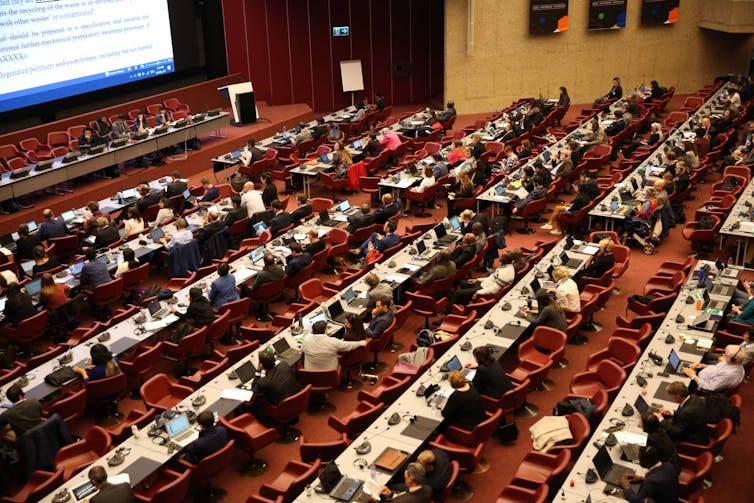
Delegates negotiate the text to determine which plastics will be regulated by the UN decision. IISD/ENB | Kiara Worth, Author provided
The negotiations held in Geneva over two weeks were intended to bring urgent action to address a complex issue. A few countries, such as Argentina and the US, were more cautious, as exporters of plastic waste themselves. They, like the recycling industry, warned that regulations could make it more difficult to recycle plastic, at a time when much more needs to be recycled. Statements went on for hours as developing countries recounted the plastics littering their lands, seas, beaches and even glaciers.
Norway brought forward a proposal to change how the treaty regulates plastics, by moving many types of plastics from the “non-hazardous” category to a list of wastes “of special concern.”
Starting in 2020, this will require developing countries to be informed if these plastics are in a waste shipment. With this information, countries can give, or revoke, their “prior informed consent”. For the first time, developing countries can refuse a shipment of plastics with the backing of international law.
Making the recycling industry fairer
This decision only applies to low-value, hard-to-recycle plastics. Think of food packaging or single-use water bottles: the plastics are soiled or mixed together (the lid, label, and bottle are different types of plastic), making them difficult to recycle. Most recyclers don’t want these plastics, which don’t generate a profit and increasingly are dumped in the landfills of poor countries.
Research shows how cheap plastics leach persistent organic pollutants into the environment – a particularly nasty group of chemicals that are toxic, travel through air and water over long distances, accumulate in animal tissue (including humans), and last a long time. More than 233 marine species have ingested plastic and litter has reached the deepest parts of the ocean.
The trade in global plastics is one driver of this problem, so giving developing countries the right to know what is entering their country and to refuse it is an appropriate solution to waste dumping.
China, previously the world’s largest importer of plastics for recycling, banned the import of cheap and contaminated plastics in 2018, displacing plastic waste to other countries. China’s neighbours, such as Indonesia, and Malaysia, shouldered a heavier burden, particularly since countries like the UK continue to export over 600,000 tonnes of plastic a year.
Rich countries tend to produce the most plastic waste in the world per person and have better systems for managing it. If cheap and easy routes for dumping plastics close, wealthier countries may have to find ways to compel recycling companies to deal with their cheap plastics domestically.
This agreement is only the start, but it could empower poorer countries to refuse the deluge of plastics that ultimately end up lingering on their shores. In time, it may help redress some of the burning injustices in the global waste trade.