


 Federal Reserve Balance Sheet Reduction: Brookings Research Outlines Possible Path Forward
  ANZ and Westpac Forecast Two RBA Rate Hikes in March and May 2026
  Goldman Sachs Raises ECB Rate Hike Forecast Amid Persistent Energy-Driven Inflation
  China Holds Benchmark Loan Prime Rate Steady for Tenth Consecutive Month
  Bank of Japan Holds Rates Steady Amid Iran War Inflation Fears
  Meta and Google just lost a landmark social media addiction case. A tech law expert explains the fallout
  RBA Set to Hike Rates Again Amid Inflation Surge and Global Uncertainty
  US-Iran Ceasefire Talks Underway: What You Need to Know


RBI Eases Policy, Embraces Accommodative Stance
Reserve Bank of India (RBI) on 9th April 2025, cut its policy repo rate by 25 basis points to 6% in the Monetary Policy Committee (MPC) meeting, the second straight rate cut under Governor Sanjay Malhotra. Shedding its traditional approach, the RBI also pursued an "accommodative" monetary policy to energize economic growth amidst global uncertainties like U.S. tariffs that are testing India's export-oriented industries. In doing so, the RBI has tried to boost the economy by reducing the cost of borrowing for people and corporations.
Inflation Within Target, but Global Headwinds Prompt Action
The RBI action preceded India's Feb 2025 retail inflation reading of 3.61% below RBI's 4% target. Despite this, owing to global trade tensions and a U.S. move to charge a 26% tariff for Indian imports, the RBI slashed its FY26 GDP growth prediction. The reduction in interest is a pre-emptive strike to counterbalance the probable deleterious effects of these outside shocks on India's economy.
Market Response Muted as RBI Balances Growth and Inflation
After the announcement, the yield on the 10-year government bond dipped marginally, the rupee dipped marginally, and equity indices dipped around 0.3% each. The RBI move reflects its commitment to strike a balance between economic growth stimulus and controlling inflation in challenging global economic times. The "accommodative" policy reflects a penchant for preferring rate reduction or keeping rates unchanged at the mercy of extraordinary events alone.
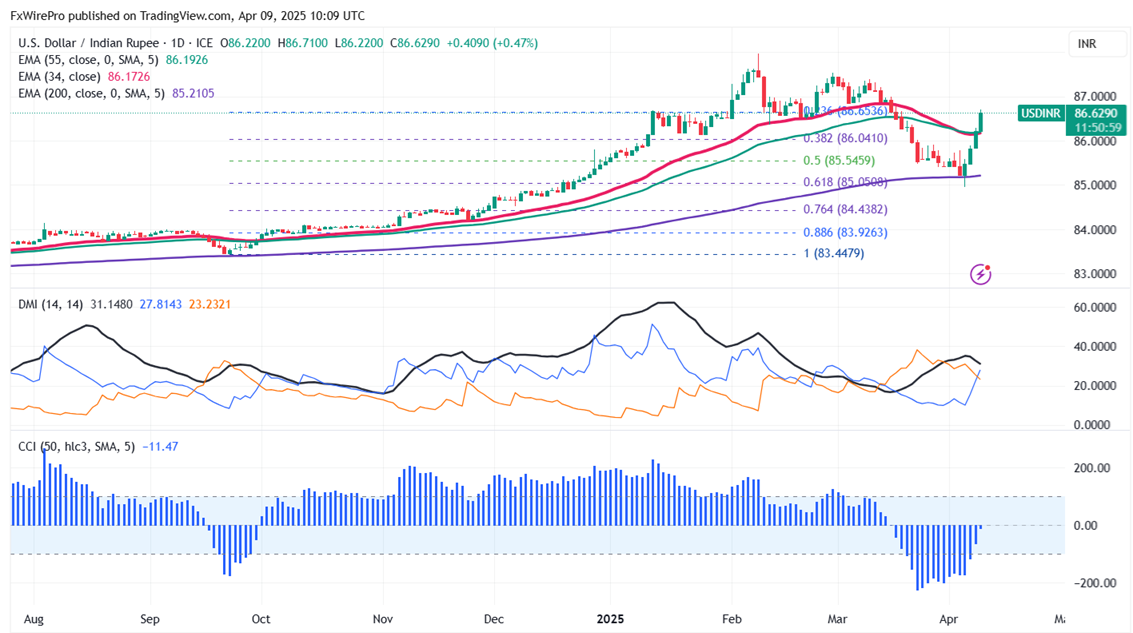
Technicals-
Major resistance- 88
Near-term resistance - 86.85
Minor support- 86,85
Trend reversal level- 84.80







