


 SpaceX Nasdaq 100 Weight to More Than Double in Rebalance
  Petrobras Joins Brazil’s New Diesel Subsidy Program
  Nike Earnings at Risk as UBS Cuts Price Target to $42
  Telix to Acquire Germany’s ITM in $1.65 Billion Radiopharma Deal
  Prysmian, Rio Tinto Supply Low-Carbon Cables for Amazon Ohio Data Center
  Volkswagen Shares Slide After 2026 Profit Outlook Cut
  SoftBank Launches $11 Billion Bond Sale to Fund OpenAI Investment
  China Vanke Shares Jump as Beijing Moves to Ease Debt Pressure
  FAA Allows Boeing to Sell 35 More 777F Freighters Beyond 2028
  NASA, Boeing Discuss Expanding Starliner Missions
  US Northeast Airports Resume Operations After Telecom Outage Disrupts Thousands of Flights
  Trump Bans CNN, MS NOW and Politico From White House
  Meta Partners With Shopify to Bring Shop Pay Checkout to Muse AI
  China Reviews Broadcom Switch Use in State Data Centres
  Trump Plans Federal AI Force and AI Czar
  Westinghouse Targets $50 Billion Valuation in U.S. IPO
  Hyundai CEO Warns Chinese Automakers Could Disrupt US Market


 Add as a preferred source on Google
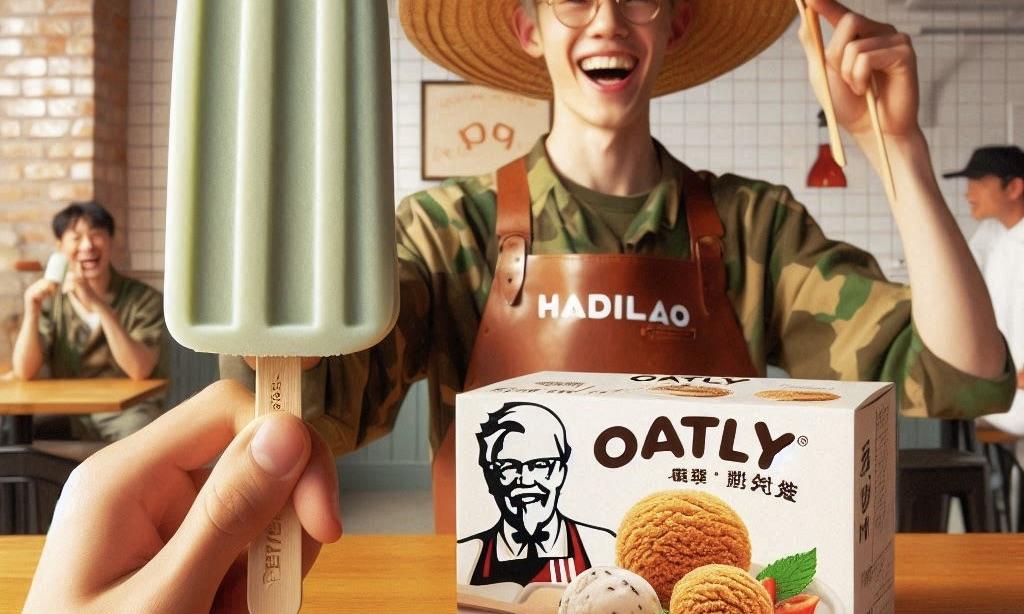
Oatly, the Swedish oat milk giant has collaborated with Haidilao and KFC to launch new vegan popsicles in China. This partnership brings consumers innovative, plant-based frozen treats, aligning with the growing demand for healthier options in the country.
Oatly Partners with KFC and Haidilao to Launch New Vegan Popsicles in China
The Swedish oat milk behemoth Oatly has formed a partnership with the fast-casual chain KFC and the hotpot titan Haidilao to introduce new vegan popsicles to restaurants in China.
According to Green Queen, Oatly has introduced two grape and guava-flavored fruit popsicles at Haidilao, the world's largest hotpot chain. The restaurant is among the five most valuable brands globally, and KFC is one of the few companies that has surpassed it. The company has partnered with Oatly to provide a limited-edition citrus-flavored ice lolly.
It follows the introduction of various zero-sugar oat milk ice creams in the market to accommodate a growing number of health-conscious consumers.
Oatly Teams Up with KFC and Haidilao to Debut Exclusive Vegan Popsicles in China
The oat-based fruit popsicles at Haidilao were explicitly engineered to compliment hot pots, offering a refreshing sensation to the frequently spicy and consistently piping-hot dish. The delights are a creamy, sweet, and sour offering that counterbalances the meal, as they combine Oatly's milk with fresh fruits.
In contrast, Oatly's KFC popsicle, the Bursting Citrus Trio, combines three distinct lemon varieties. The lemons' tanginess is moderated by malt paste and maltose syrup. Crunchy pieces of frozen candied lemon rind are also in the zesty treats.
This announcement was made months after Oatly introduced zero-sugar delights in latte, cocoa, and hazelnut varieties, indicating the increasing demand for healthier plant-based foods in China. A 2023 report by Asymmetrics Research delineated how plant-based milk brands are emphasizing attributes such as "no sugar/cholesterol/trans fat," "good for brains/eyes," and "high protein/calcium" on product packaging in addition to cleaning up their labels.
“China is promoting healthier and more nutritious food options in response to the Healthy China policy,” said David J Ettinger, chief representative officer at law firm Keller and Heckman Shanghai. “Therefore, foods offering health benefits and high nutritional value are going to likely lead the way.”
A recent poll in China revealed that 46% of consumers believed that health is the primary motivator for consuming plant-based foods. This was succeeded by nutrition, which accounted for 39%. Meanwhile, 36% of respondents identified the freshness of ingredients as the most significant obstacle. Consequently, Oatly's emphasis on this issue is expected to be well-received by consumers.
Oatly, which introduced ice cream in China for the first time in 2022, will be able to turn its fortunes around in the country due to its partnerships with Haidilao and KFC. The oat milk manufacturer has been experiencing an extended sales decline, attributed to a "slower-than-anticipated recovery" following the COVID-19 pandemic.
The company's revenue in Asia decreased by 19% last year, with China comprising 93% of the market. "The consumer environment in Greater China continues to be difficult." COO Daniel Ordonez stated in May, "We are identifying opportunities to rebuild our business in a disciplined manner."
“While it is clear we have not yet gained the traction needed for this business to capture the full opportunity that region provides, you can see we’re starting to make progress on the second stage of this segment’s turnaround plan,” he added.
Oatly's Strategic Restructuring in China Targets Growth and Market Adaptation
This year, Oatly has reorganized its operating segments as part of its strategic reset in China. Greater China, which encompasses Hong Kong and Taiwan, is now managed separately from Asia-Pacific. Asia-Pacific has been consolidated into a new Europe & International section, which includes Latin America, Europe, the Middle East, and Africa.
During the Q1 earnings call this year, Ordonez stated the following: The business's revenue decreased by 27% yearly, and the Greater China region accounted for 11% of its sales in the quarter. Oatly had already initiated the elimination of low-margin SKUs from e-commerce and retail, and the company has now intensified its focus on food service.
E-commerce contributed 13% of the brand's Q1 revenue in Greater China, while the latter channel accounted for 70%. This indicates the necessity of a distinct strategy in this region, as retail dominated revenue in its other markets.
“Sensitive to the economic context prevailing in China and the new consumer behavior, it was clear we needed to complement our portfolio with SKUs that could hit certain price points,” Ordonez said. “This helps us to build a stronger service package for our customers, drive volume growth to sustain necessary levels of capacity absorption, and hence, solidify our margins.”
Last month, David Zhang, the Greater China president of Oatly, shared with Campaign Asia his reflections on the company's voyage in China and its future strategy. Zhang compared categories to forests, brands to trees, and businesses to fruit. "Initially, there is a forest, followed by trees, and, in the end, fruit." The absence of a forest would result in the breeze carrying the trees away. He clarified that a brand can only be considered legitimate once a category has been established.
Zhang underscored the significance of comprehending cultural distinctions and values within the consumer packaged goods (CPG) industry. “We’ve discovered that numerous Nordic concepts are compatible with fundamental human logic, such as ‘less is more’, ‘lagom’ (Swedish for ‘just right’), and ‘sustainable development’. These concepts are also relevant in China,” he said.
“In China, Oatly not only highlights the functionality of its products but also chooses to use them to represent a lifestyle. We discuss the Nordic way of life and position environmental protection and sustainability as our distinctive attributes, together with the importance of design and creativity as our primary focus, to showcase our unique strengths and qualities.”
Zhang added that the demand for oat milk has constantly risen in China. “The challenge of shifting from a ‘niche’ to ‘daily’ means increasing the consumer base and its diverse needs,” he stated. “At the same time, it is an opportunity for Oatly to maintain keen market insights and create R&D capabilities to meet the diversified needs of the general public for oat-based products.”







