


 Elon Musk’s Empire: SpaceX, Tesla, and xAI Merger Talks Spark Investor Debate
  Baidu Approves $5 Billion Share Buyback and Plans First-Ever Dividend in 2026
  Oracle Plans $45–$50 Billion Funding Push in 2026 to Expand Cloud and AI Infrastructure
  Nintendo Shares Slide After Earnings Miss Raises Switch 2 Margin Concerns
  Nvidia Confirms Major OpenAI Investment Amid AI Funding Race
  What’s so special about Ukraine’s minerals? A geologist explains
  An unexpected anomaly was found in the Pacific Ocean – and it could be a global time marker
  AMD Shares Slide Despite Earnings Beat as Cautious Revenue Outlook Weighs on Stock
  Thousands of satellites are due to burn up in the atmosphere every year – damaging the ozone layer and changing the climate
  Drug pollution in water is making salmon take more risks – new research
  Wildfires ignite infection risks, by weakening the body’s immune defences and spreading bugs in smoke
  How to create a thriving forest, not box-checking ‘tree cover’
  The UK is surprisingly short of water – but more reservoirs aren’t the answer
  SoftBank Shares Slide After Arm Earnings Miss Fuels Tech Stock Sell-Off
  Sony Q3 Profit Jumps on Gaming and Image Sensors, Full-Year Outlook Raised
  Tencent Shares Slide After WeChat Restricts YuanBao AI Promotional Links



Hurricane Ian left an extraordinarily broad path of destruction across much of South Florida. That was evident in reports from the ground, but it also shows up in satellite data. Using a new method, our team of spatial and environmental analysts was able to quickly provide a rare big picture view of damage across the entire state.
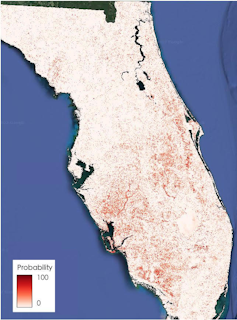
Satellite images and artificial intelligence reveal Hurricane Ian’s widespread damage. The dark areas have a high probability of damage. Su Ye
By using satellite images from before the storm and real-time images from four satellite sensors, together with artificial intelligence, we created a disaster monitoring system that can map damage in 30-meter resolution and continuously update the data.
It’s a snapshot of what faster, more targeted disaster monitoring can look like in the future – and something that could eventually be deployed nationwide.
How artificial intellegence spots the damage
Satellites are already used to identify high-risk areas for floods, wildfires, landslides and other disasters, and to pinpoint the damage after these disasters. But most satelite-based disaster management approaches rely on visually assessing the latest images, one neighborhood at a time.
Our technique automatically compares pre-storm images with current satellite images to spot anomalies quickly over large areas. Those anomalies might be sand or water where that sand or water shouldn’t be, or heavily damaged roofs that don’t match their pre-storm appearance. Each area with a significant anomaly is flagged in yellow.
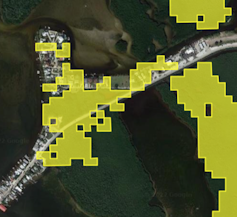
Damage detected in the same area of Matlacha as in the photo. Su Ye
Five days after Ian lashed Florida, the map showed yellow alert polygons all over South Florida. We found that it could spot patches of damage with about 84% accuracy.
A natural disaster like a hurricane or tornado often leaves behind large areas of spectral change at the surface, meaning changes in how light reflects off whatever is there, such as houses, ground or water. Our algorithm compares the reflectance in models based on pre-storm images with reflectance after the storm.
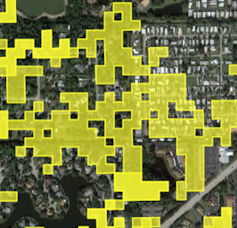
Damage in the same part of Punta Gorda shown in the photo. Su Ye
The system spots both changes in physical properties of natural areas, such as changes in wetness or brightness, and the overall intensity of the change. An increase in brightness often is related to exposed sand or bare land due to hurricane damage.
Using a machine-learning model, we can use those images to predict disturbance probabilities, which measures the influences of natural disaster on land surfaces. This approach allows us to automate disaster mapping and provide full coverage of an entire state as soon as the satellite data is released.
The system uses data from four satellites, Landsat 8 and Landsat 9, both operated by NASA and the U.S. Geological Survey, and Sentinel 2A and Sentinel 2B, launched as part of the European Commission’s Copernicus program.
Real-time monitoring, nationwide
Extreme storms with destructive flooding have been documented with increasing frequency over large parts of the globe in recent years.
While disaster response teams can rely on airplane surveillance and drones to pinpoint damage in small areas, it’s much harder to see the big picture in a widespread disaster like hurricanes and other tropical cyclones, and time is of the essence. Our system provides a fast approach using free government-produced images to see the big picture. One current drawback is the timing of those images, which often aren’t released publicly until a few days after the disaster.
We are now working on developing near real-time monitoring of the whole conterminous United States to quickly provide the most up-to-date land information for the next natural disaster.













