


 Luxshare Shares Rise as First-Half Profit Jumps 18%
  SoftBank Eyes $20 Billion Bond Sale to Refinance OpenAI Loan
  Nvidia Options Price in $280 Billion Earnings Swing
  Xiaomi Unveils Xring O3 Chip for Flagship Foldable Phone
  Mercer International Stock Surges 45% on C$20 Million Canada Funding
  Tokio Marine Eyes Multibillion-Dollar Suncorp Takeover
  U.S. Probes Apex Logistics Over Nvidia AI Chip Shipments to China
  Tesla Raises Cybertruck Prices by $5,000 in US
  SK Biopharmaceuticals Secures Global Rights to Biohaven Epilepsy Drug Opakalim
  BofA Names ASML Top Semiconductor Equipment Pick on Growth, Valuation
  29 US states are suing Meta. What might it mean for the rest of the world?
  Australia’s Big Four Banks Face Mortgage Slowdown as Valuations Draw Scrutiny
  Google Expands Gemini Enterprise With AI Tools for Legal Sector
  Yindjibarndi Appeals Fortescue Mining Compensation Ruling
  Countries Tighten Social Media Bans for Children
  Trump Buys SpaceX Shares After Record IPO


 Add as a preferred source on Google
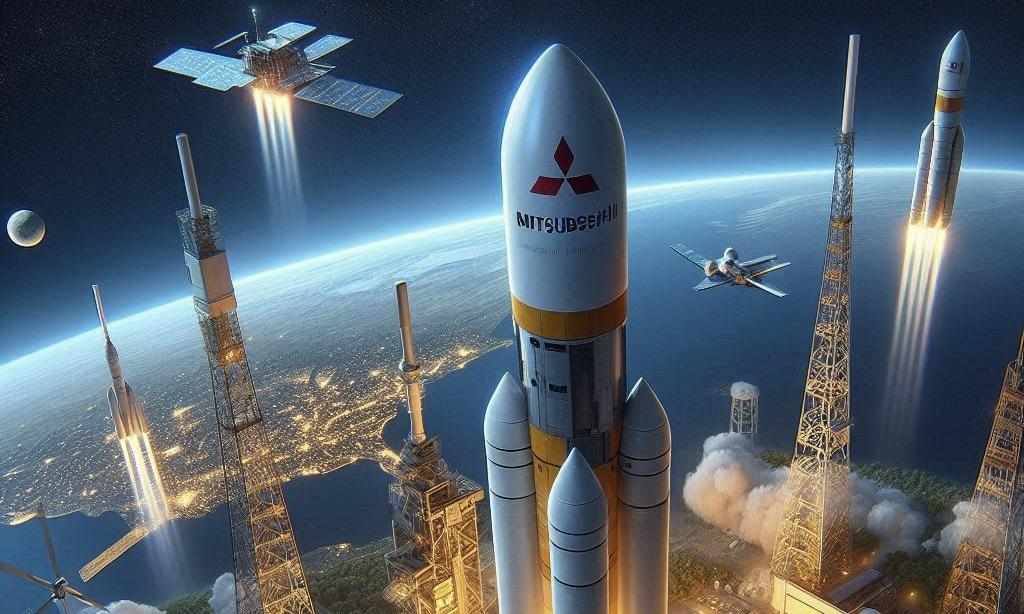
Mitsubishi Heavy Industries will begin launching multiple satellites for French operator Eutelsat in 2027 using its H3 rocket. This partnership marks a significant milestone for Mitsubishi's efforts to compete globally in the commercial launch industry, offering a cost-effective alternative to SpaceX.
Mitsubishi Heavy Expands Commercial Launch Efforts with Eutelsat Satellite Deal Using H3 Rocket
Mitsubishi Heavy Industries has secured the second commercial customer for its new H3 launch vehicle. According to Nikkei Asia, the vehicle will launch multiple satellites for French satellite operator Eutelsat. This move significantly boosts the Japanese company's efforts to establish itself as a viable participant in the commercial launch industry.
Mitsubishi Heavy has been responsible for developing and operating Japan's primary launch vehicles for decades. However, the services have been primarily provided to government agencies, including the Japan Aerospace Exploration Agency (JAXA) and the International Space Station.
The H3 medium-lift launch vehicle has been operational since this year, with the distinct objective of offering a competitive service in the global market. In 2018, Inmarsat, a British satellite telecommunications corporation now a California-based Viasat subsidiary, was announced as the H3's inaugural commercial customer.
The Paris-based company operates a low-earth-orbit constellation of over 600 satellites, which it acquired with OneWeb last year. Additionally, Eutelsat operates 35 geostationary satellites.
Mitsubishi Heavy to Begin Eutelsat Satellite Launches with Cost-Effective H3 Rocket in 2027
According to a statement issued by the Japanese company on September 18, the launches will commence in 2027. The two companies did not specify the type of satellite or the orbit into which it will be launched.
According to Eutelsat, utilizing the H3 launch vehicle "provides supplementary opportunities and diversity" for satellite launch. SpaceX rockets have recently been used to launch Eutelsat satellites.
The H3 rocket is Japan's response to SpaceX's Falcon 9, the world's most extensively used launch vehicle, and is designed to succeed the H2A rocket, which is scheduled to be retired by March.
Mitsubishi Heavy's objective with the H3 is to reduce the launch cost by 50% to $50 million, a figure the company claims is comparable to Falcon 9. Although H2A achieved a 98% success rate in its launch, it has yet to be commercially successful due to its excessive costs. It has transported satellites for the space agencies of South Korea and the United Arab Emirates, as well as for entities such as Telesat of Canada and Inmarsat of the United Kingdom.
Mitsubishi Heavy and JAXA jointly developed the H3 rocket, a successor to the H2A and H2B rockets.
Two additional H3 and H2A rockets are scheduled for the fiscal year ending in March 2025. The most recent H3 launch occurred in July.







