


 Best Gold Stocks to Buy Now: AABB, GOLD, GDX


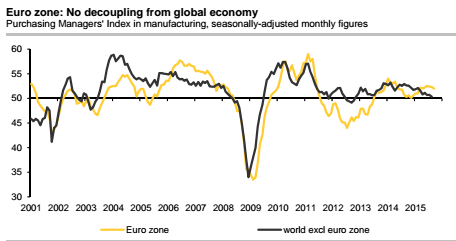
The euro-zone economy is still on a moderate growth path as Purchasing Managers' Index indicates. At the same time, global demand weakness is dampening the economy in the industrial countries. The euro area Purchasing Managers' Index for the manufacturing sector fell only marginally in September, from 52.3 to 52.0. Thus, the likelihood has decreased for the forecast that the ECB will expand its asset purchase programme this year already, says Commerzbank.
The global economy outside the euro area is growing at an ever-decreasing pace. In the meantime, the global Purchasing Managers' Index (PMI) for the manufacturing sector without the euro zone is close to the critical mark of 50. A level under 50 points to a fall in industrial production. What is surprising is that the PMI for the euro zone has decoupled itself so far from the global downward trend. The slight decline of the index in September from 52.3 to 52.0 changes nothing.
One reason why sluggish global demand has not left any deeper marks on the euro-zone economy so far is undoubtedly the weaker euro. Improved price competitiveness is allowing companies in the euro zone to compensate for weaker global demand partly through increasing their shares of markets. In addition, energy is cheaper, which is boosting domestic demand.
"Weaker demand from the emerging countries is likely to slow economic growth in the euro zone. But before this is visible in the figures, the ECB is likely to hesitate in expanding its asset purchase programme", anticipates Commerzbank.

- News

- Economy

- Central Banks
- Investing
- Research
- Roundups
- Digital Currency
- Insights
- Technical Analysis
- Technology
- Business
- Law
- Health
- Nature
- Fintech
- Science
- Topic
- Opinions
- ©Econometrics LLC . All Rights Reserved.
Is eurozone immune against EM weakness?
Wednesday, September 23, 2015 9:39 AM UTC
Editor's Picks



- Market Data
Most Popular




