


 Oil Prices Steady as U.S.-Iran Peace Talks Ease Strait of Hormuz Supply Fears
  JPMorgan Cuts Gold Price Forecast, Sees Bullion Reaching $4,500 by End of 2026
  Oil Prices Slip as OPEC+ Boosts August Output, Oversupply Concerns Weigh on Crude Market
  Asian Markets Slip as AI Earnings Season Looms, Oil Prices Fall Ahead of Key Fed Signals
  Russia Stocks End Flat at Three-Year Low as MOEX Index Stalls, Gold Prices Climb
  Asia Stocks Fall as Samsung Earnings Fail to Ease AI Valuation Concerns
  Denmark Central Bank Intervenes to Support Krone Peg Against Euro
  Goldman Sachs Flags 3 Key Risks Ahead of Europe’s Earnings Season
  Asian Currencies Rise as Dollar Weakens; Yen Holds Steady Amid Japan Intervention Watch
  US Stock Futures Rise as Investors Eye Fed Minutes, AI Stocks, and Q2 Earnings
  Gold Price Surges Above $4,120 as Weak US Jobs Data Lowers Fed Rate Hike Expectations
  Oil Prices Rise as Strait of Hormuz Risks Offset OPEC+ Supply Increase
  Cuba Power Grid Collapse Triggers Nationwide Blackout Amid Deepening Energy Crisis
  Asian Stocks Rebound as Tech Shares Rally on Fed Rate Cut Hopes and Easing Iran Tensions
  Oil Prices Slip as Oversupply Concerns and U.S.-Iran Talks Shape Market Outlook
  Goldman Sachs Raises USD/JPY Forecast, Sees Yen Weakness Persist Through 2027
  Gold Price Today: Bullion Heads for First Weekly Gain as Weak U.S. Jobs Data Eases Rate Hike Fears



The U.S. unemployment rate climbed from a half-century low of 3.5% to 4.4% in March – and is expected to go a lot higher.
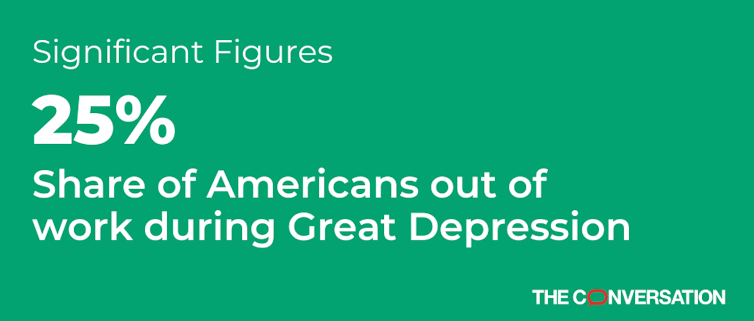
But could the rate, as some predict, surpass the 25% joblessness the U.S. experienced at the peak of the Great Depression?
As a macroeconomist who has tracked the labor force for decades, I’ve been wondering about this myself.
There are actually two figures the Bureau of Labor Statistics uses to estimate employment levels in the U.S.
One is the unemployment rate, which comes from the Current Population Survey. The U.S. Census Bureau contacts about 60,000 randomly selected households every month to get an estimate of this rate.
The other is an estimate of how many nonfarm jobs were lost or created in the month. The Bureau of Labor Statistics creates these figures by asking more than 140,000 private businesses, nonprofits and various state and local governments how many people were on their payroll at any time during the week containing the 12th of the month.
The latest data show the economy lost 701,000 jobs in March.
But these are just very early estimates of the impact from the coronavirus. It will get a lot worse before it gets better. About 10 million people have applied for employment benefits in the past two weeks alone.
The employment surveys – single-week snapshots – were both taken in mid-March, around the time the U.S. first began to experience a sharp uptick in cases, and some states, such as New York and California, ordered businesses to close. Both surveys likely only reflect the very early effects of the pandemic.
In addition, they consider someone employed even if they worked only part of that week. Starting off the week employed and ending the week laid off means a person is still considered “working.”
So we won’t begin to see the full scale of the jobs impact until early May, when the April data are released.
So how high could joblessness get?
The record unemployment rate came in 1933, when a quarter of adults who wanted to work couldn’t find a job.
Back then, the U.S. only estimated annual labor market data. More precise monthly data didn’t begin until 1948. Since then, the highest monthly unemployment rate ever recorded was 10.8% in December 1982 as a result of the Federal Reserve increasing borrowing costs to fight inflation.
If unemployment in the U.S. does reach 25%, the country would hardly be alone in the world. In fact, before the pandemic, 22 countries including South Africa and Kenya were experiencing estimated unemployment rates over 25%, according to the CIA, which tracks data like this because high unemployment sometimes lead to social instability and government collapse. Burkina Faso, a small country in West Africa, had unemployment north of 75%.
With governments continuing to work on bailout and stimulus programs aimed at mitigating the pandemic’s impact on the economy, it’s impossible to really know how high joblessness will get. These efforts may prevent the worst.
In my view, however, I do believe that no matter what, it will be short-lived. The economy will rebound when life – and our pent-up desire to eat out, shop and spend – returns to normal, eventually.
 Jay L. Zagorsky does not work for, consult, own shares in or receive funding from any company or organisation that would benefit from this article, and has disclosed no relevant affiliations beyond their academic appointment.







