


 Moderna Short Sellers Hit With $4.8 Billion Loss as Stock Soars
  FDA Weighs Safety Standards for Psychedelic Therapies
  AstraZeneca Q2 Earnings Beat Forecasts as Oncology Growth Supports 2026 Outlook
  Moderna Wins FDA Approval for mFLUSIVA mRNA Flu Vaccine for Adults 50+
  Novo Nordisk Raises 2025 Outlook Despite Wegovy Pill Miss and CagriSema Setback
  Hanmi Pharm Soars 30% on $2.3 Billion Genentech Obesity Drug Deal
  France Keeps Top Health Alert as Officials Brace for Another Heatwave
  GLP-1 Weight-Loss Drug Use Surges Among U.S. Children
  Trump Administration Bars U.S. Travelers From Congo Flights Amid Ebola Outbreak
  Alcohol is one of the most dangerous drugs, yet its presence is ubiquitous in social settings and celebrations
  Venezuela Earthquake Health Risks Rise as Disease Monitoring Intensifies
  Novartis M&A Strategy Faces Investor Scrutiny After Drug Setbacks
  Hims & Hers Shares Fall as GLP-1 Costs Widen Q2 Loss


 Add as a preferred source on Google



Health professionals may suggest people spend more time out in nature to help with their physical fitness by doing activities in woods, parks or gardens, but research has shown nature-based programmes are also particularly effective for improving poor mental health.
Our previous work showed that important aspects of why these programmes work include increased connection to nature, time away from the pressures of daily life, a greater sense of purpose, the learning of new skills, physical activity and increased opportunities for social interactions.
Growing evidence now shows that spending time in a natural environment could also improve the health and wellbeing of people with experience of drug and alcohol problems.
Activities offered on these programmes can include hiking, camping, gardening, conservation activities and adventure activities such as rock climbing, among others.
Although there’s increased awareness that time in nature may benefit people with drug and alcohol problems, there has been limited research until now, particularly in the UK, into how best to design effective nature-based programmes for this group.
During our study, we spoke to staff working in nature-based programmes for people with poor mental health and substance use issues, and researchers interested in the role of nature for health, among others. They told us the reasons why these programmes are effective for people with drug and alcohol problems are similar to why they improve mental health.
For example, participants benefit from escaping daily stresses and having space to reflect. The increase in physical activity also improves overall health.
The confidence people gain from doing new activities can help them to regain a sense of purpose. This can lead to positive changes whereby they no longer feel defined solely by their substance use.
They can also feel less alone, thanks to relationships built with staff and others using the programmes. This is important given the high levels of loneliness and isolation reported by many people with alcohol and drug problems.
Finally, the development of relationships with other people on the programmes who haven’t faced drug and alcohol problems can reduce stigma. We know stigma experienced by people with drug and alcohol problems can increase the likelihood of harm from substances and reduce inclination to get help.
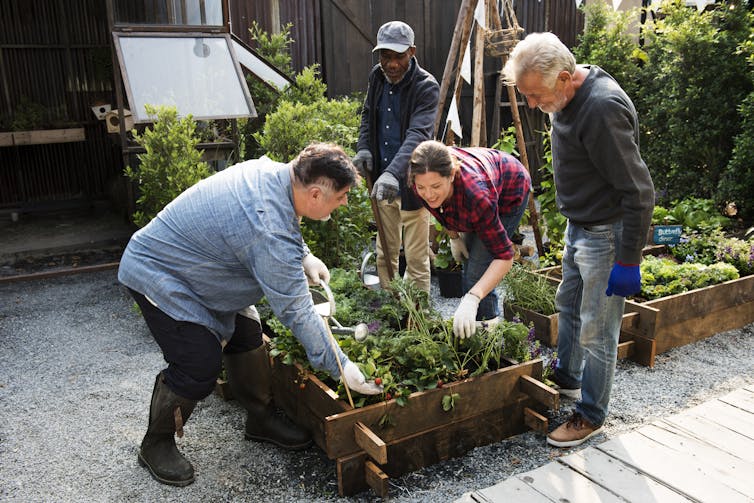
Nature-based programmes can foster social connections. Rawpixel.com/Shutterstock
Although exposure to nature in this way could lead to reductions in substance use, it’s important to note this isn’t the explicit aim of these programmes. Nature-based schemes don’t usually require a commitment to reduce or completely stop the use of drugs and alcohol that’s often present in other treatment settings.
The focus instead is on wider components of health, meaning nature-based programmes can benefit people whether they’re trying to reduce their substance use or not.
With the insights from this research, we created a new framework showing how positive outcomes are achieved from nature-based programmes for people with poor mental health and drug and alcohol problems.
The framework shows how it’s the interaction between time in nature, changes within a person (such as increased confidence), and shifts in social relationships which lead to positive, holistic results. We hope that, based on our findings, programmes can be designed and implemented more effectively for this group of people.
High levels of drug-related deaths
In 2021, there were 4,859 drug-related deaths registered in England and Wales, and 1,330 in Scotland. In the same year, 9,641 alcohol-related deaths were recorded in the UK.
Notably, drug- and alcohol-related harm is not equal across all social groups. For example, in deprived areas of Scotland, deaths from both drugs and alcohol are significantly higher.
Politicians, researchers and drug treatment experts have described the level of drug-related harm in the UK as a public health emergency.
However, people facing problems with drugs and alcohol can find both addiction and mental health services challenging due to stigma, previous negative experiences, and unrealistic expectations about stopping substance use.
Adding nature-based programmes as an approach to treatment has the potential to address several policy recommendations in drug and alcohol policy in Scotland and the wider UK.
For example, tackling stigma, delivering a holistic approach, increased focus on engaging with those who don’t currently access services, and more support for community-based projects, have all been highlighted as ways to improve access to support and treatment. Nature-based programmes for people with drug and alcohol problems aim to meet all of these objectives.
Also, programmes can provide support for people who have difficulties with both substance use and mental health. This is important because 70% of people using drug services and 86% of people using alcohol services also experience mental health problems.
If used as part of a substance use treatment plan where the service user’s preferences and needs are prioritised. Nature-based programmes could be a viable solution for supporting people with drug and alcohol problems at a time when related harms are rising.
Increasing pressure on drug and alcohol services to deliver support to people with many different, complex needs means that exploring new initiatives, like nature-based programmes, is now essential – particularly among those already facing health and social inequalities.







