


 Stuck in a creativity slump at work? Here are some surprising ways to get your spark back
  Columbia Student Mahmoud Khalil Fights Arrest as Deportation Case Moves to New Jersey
  Time to buy local: war fuel price shocks reveal the folly of a long food supply chain
  SK Biopharmaceuticals Secures Global Rights to Biohaven Epilepsy Drug Opakalim
  The pandemic is still disrupting young people’s careers
  US-Canada Tariff War Escalates With 50% Auto Duties
  Office design isn’t keeping up with post-COVID work styles - here’s what workers really want
  Asian Stocks Rebound as Oil Prices Fall, Nvidia Earnings in Focus
  US Stocks Finish Flat as Inflation Data, Nvidia Earnings Keep Investors Cautious
  US PCE Inflation Holds at 3.7% as Fed Rate Decision Looms
  Google promotes ‘teacher approved’ apps for kids. Here’s what parents should know
  Dollar Rises as Hotter PCE Inflation Lifts Fed Rate Hike Bets
  Luxshare Shares Rise as First-Half Profit Jumps 18%
  Asian Currencies Mixed as Aussie Dollar Rises on Hot Inflation
  Heritage, desire and diplomacy: why China still values scotch whisky
  Gold Prices Rise Toward $4,650 Ahead of Warsh’s Jackson Hole Speech


 Add as a preferred source on Google
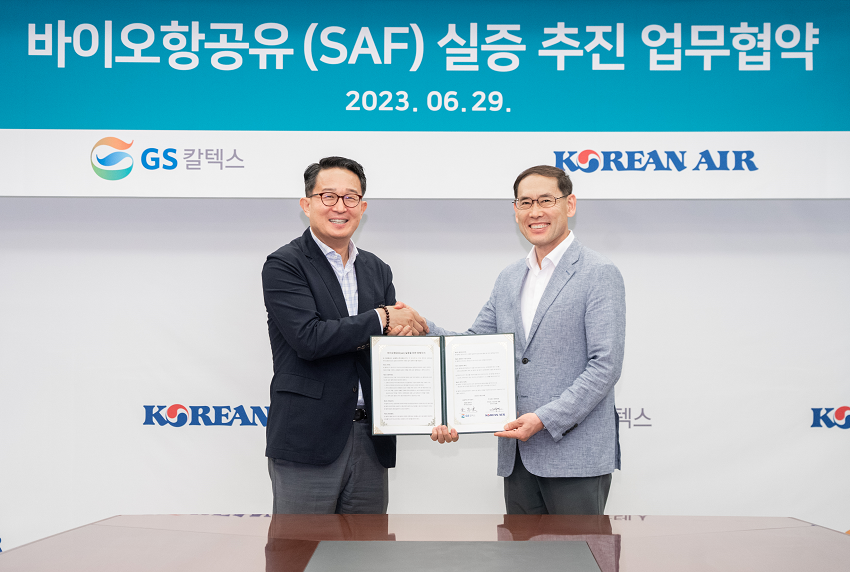
GS Caltex and Korean Air have announced a partnership to carry out test flights using sustainable aviation fuel (SAF), or biofuel, for select international departures from Incheon, a breakthrough move towards cleaner, greener energy and significant reduction of carbon emissions. This initiative aligns with the Korean government's push for increased biofuel supply and sets a crucial precedent in aviation's transition to environmental sustainability.
Scheduled to commence in the second half of 2023, these test flights will span six months. This collaboration is in line with the government's initiative to bolster the supply of biofuels. Pending the results of these test flights, the Korean government intends to establish guidelines for the domestic usage of SAF and set quality standards before full-scale domestic production.
SAF, in contrast to nonrenewable fossil fuels, is derived from animal or vegetable oils, algae, and solid waste. It boasts the ability to reduce carbon emissions by up to 80 percent when compared to traditional fossil jet fuel.
The European Union has mandated that airlines refueling within its jurisdiction incorporate a minimum 2 percent SAF blend by 2025. Furthermore, numerous countries, including the United States, are adopting policies such as tax incentives to promote the expansion of SAF production.
The International Civil Aviation Organization has also been actively advocating for the net-zero mission in international flight operations, urging states to commit to the goal of achieving net zero by 2050.
The collaboration between GS Caltex and Korean Air heralds an exciting leap forward in the pursuit of sustainable air travel, highlighting their commitment to environmental responsibility and the future of aviation.
Meanwhile, Korean Air now offers a new and exciting experience for premium passengers traveling between Seoul and Phnom Penh. Starting July 1st, travelers on this route will be among the first to enjoy fully lie-flat seats on Korean Air's Airbus A321neo aircraft.
The A321neo boasts a two-class layout with a total of 182 seats. This includes eight luxurious fully-lie flat seats in the Prestige Class cabin, while the economy cabin offers 174 seats. Passengers in Prestige Class can enjoy a spacious 44-centimeter (17-inch) personal monitor for audio/video-on-demand services and an in-seat wireless smartphone charger. Economy passengers have a comfortable 33-centimeter (13-inch) monitor, and all guests have the convenience of Bluetooth pairing to the inflight entertainment system.
Photo: Korean Air Newsroom







