


 Urban studies: Doing research when every city is different
  Wall Street Analysts Weigh in on Latest NFP Data
  US Gas Market Poised for Supercycle: Bernstein Analysts
  BOJ Policymakers Warn Weak Yen Could Fuel Inflation Risks and Delay Rate Action
  Fed Governor Lisa Cook Warns Inflation Risks Remain as Rates Stay Steady
  UBS Projects Mixed Market Outlook for 2025 Amid Trump Policy Uncertainty
  Bank of Canada Holds Interest Rate at 2.25% Amid Trade and Global Uncertainty
  BTC Flat at $89,300 Despite $1.02B ETF Exodus — Buy the Dip Toward $107K?
  Gold Prices Slide as Rate Cut Prospects Diminish; Copper Gains on China Stimulus Hopes
  US Futures Rise as Investors Eye Earnings, Inflation Data, and Wildfire Impacts


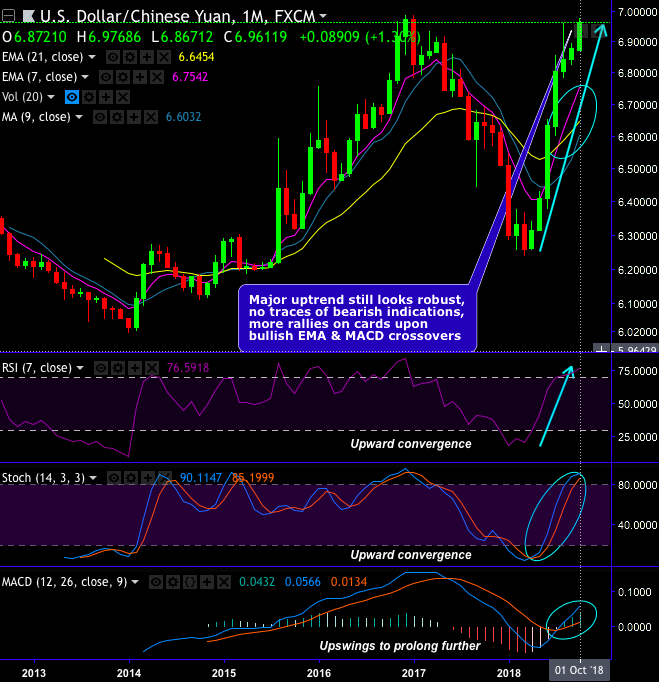
At 6.9768, USDCNH surged this morning above towards December’2016 highs of 6.9865 levels, breaching through the last technical barrier before the psychologically decisive 7 mark (refer above chart). The further upward movement is fundamentally justified. On the one hand, the Fed's cycle of interest rate hikes is strengthening the dollar, while on the other hand the restrained growth outlook in China and the easing measures of the Chinese central bank PBoC are weakening the renminbi. This dynamic is being reinforced by the trade conflict between the USA and China. The trade conflict is exerting upward pressure on import prices in the United States, which provides the Fed with an additional argument for further interest rate hikes in view of the unchanged strong economic environment. In China, on the other hand, US import tariffs have led to an additional deterioration in the growth outlook, which has further increased the headwind for the renminbi.
Potential risks of a further CNH depreciation: If the PBoC does not immediately put a stop to the depreciation of the renminbi, USDCNH is likely to rise above 7.00 soon. While such a move would only mean a slight depreciation of the renminbi, the consequences could be much more serious.
We expect that breaching this level would be met with sharp criticism from the US and could trigger a further escalation in the trade conflict. For example, USDCNY levels above 7 could be the tip of the iceberg that would make US President Donald Trump push for tariffs on all Chinese imports, with substantial consequences for the Chinese economy.
In addition, we fear that depreciation expectations for the renminbi will increase significantly as soon as PBoC allows CNH to depreciation beyond 7 against the USD. This is problematic, as the causes of the destabilizing capital flight in 2015 continue to exist.
RV framework and options structures:
The RV between USDCNH and AUDCNH options is clearer in Exhibit 3, which presents our usual conditional trade framework for evaluating relative rich/cheap for directional (live / non-delta-hedged) options.
An isopremium line of 9M options – a string of 9M maturity zero-cost long USDCNH vs short AUDCNH option strikes (assuming equal CNH notionals on both legs), presented on both axes as their percentage distance from respective spots – is overlaid on a scatter of 3-month spot returns; the slope of the isopremium line can be interpreted as the option- implied beta between the two assets, which can be compared against the historical spot return beta for an assessment of relative value. The stark asymmetry of option pricing vis-à-vis spot returns on both sides of the distribution – nearly 100% of the historical return scatter is below the isopremium line for CNH puts and above the isopremium line for CNH calls – suggests that options are anticipating excessive moves in AUDCNH in both directions for given moves in USDCNH than the empirical experience of the past few years has delivered.
This implies value in owning USDCNH strangles against AUDCNH strangles; we retain the short leg of this RV as is, but tweak the long leg to contain only USDCNH calls given our directional view of medium-term RMB weakness.
Thus, a zero-cost option implementation is proposed for owning USDCNH upside by buying USD calls/CNH puts financed by selling AUDCNH strangles (live, no delta-hedging): Off spot refs. 6.96 (USDCNH) and 4.90 (AUDCNH), buy 9M 7.12 strike (40-delta) USD calls/CNH puts vs short 9M OTM 4.50 – 5.30 AUDCNH strangle, equal CNH notionals/leg for zero-cost. The USDCNH call costs 165bp standalone (mid). Courtesy: JPM
Currency Strength Index: FxWirePro's hourly CNY spot index is inching towards -81 levels (which is bearish), hourly USD spot index was at 68 (bullish) while articulating (at 11:23 GMT). For more details on the index, please refer below weblink:













