


 US Dollar Climbs to One-Year High as Fed Rate Hike Expectations Surge
  Japan Manufacturing Growth Accelerates in June as Orders Surge Despite Iran War Cost Pressures
  New Zealand Fast-Tracks Gold Mining as Industry Revival Gains Momentum
  Oil Prices Slip as Iran Sanctions Relief and Hormuz Shipping Recovery Ease Supply Concerns
  Oil Prices Drop as Strait of Hormuz Shipping Recovers
  South Korea’s KOSPI Rebounds as Samsung and SK Hynix Lead Tech Stock Recovery
  Gold Drops Below $4,000 as Strong US Dollar and Fed Rate Hike Expectations Pressure Bullion
  Asian Stocks Slide as AI Rally Pauses, South Korean Chipmakers Lead Regional Decline


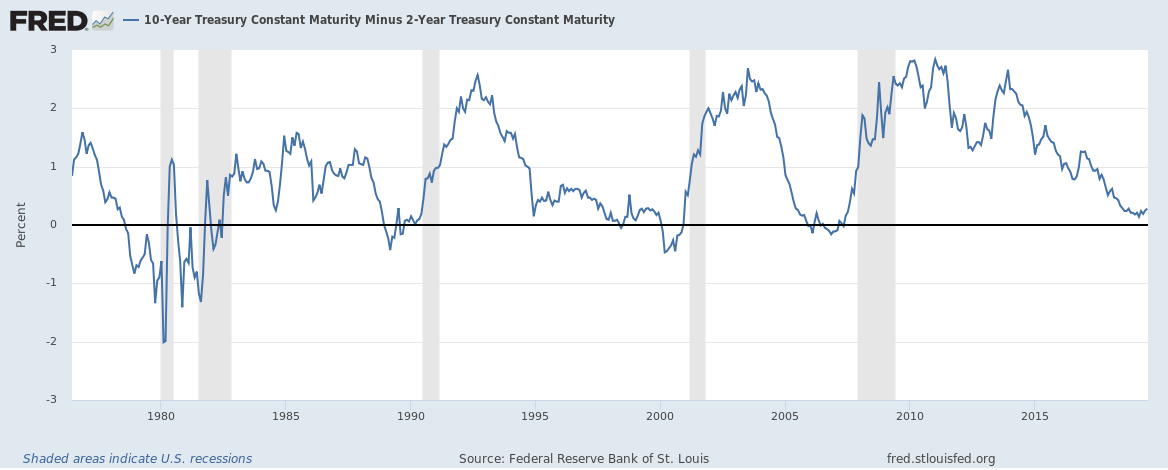
There are many indicators like PMI reports, jobs reports, inflation, industrial output, business sales, etc. that we take a look into in determining whether the US economy is slowing down and heading for a recession but there is one indicator, which we are not losing sight of, which is widely considered as the most reliable predictor of a recession and that is the yield difference between a 10-year U.S. Treasury bonds and a 2-year treasury bonds.
This chart from the St. Louis Fed’s economic dashboard shows that the spread has correctly predicted the last five recession. Every time before the US economy suffered a recession, the spread dipped below zero. Recession follows within 24 months, whenever spread dips below zero.
The spread has been steadily declining since 2014, as the U.S. Federal Reserve raised interest rates from 0.25 percent to 2.25 percent, pushing short-term rates higher, while lower inflation expectation pushed long-term yields lower.
However, there has recently been a shift upwards in this indicator, as the U.S. Federal Reserve signaled rate cuts. The upward shift further fades the possibility of an immediate recession.
Moreover, the U.S. GDP growth also suggests that the recession is still a far-fetched idea. Despite the recent slowdown, the U.S. economy grew by 3.1 percent y/y in the first quarter of 2019.







