


 US Futures Rise as Investors Eye Earnings, Inflation Data, and Wildfire Impacts
  Gold Prices Fall Amid Rate Jitters; Copper Steady as China Stimulus Eyed
  U.S. Banks Report Strong Q4 Profits Amid Investment Banking Surge
  U.S. Treasury Yields Expected to Decline Amid Cooling Economic Pressures
  Oil Prices Dip Slightly Amid Focus on Russian Sanctions and U.S. Inflation Data
  UBS Predicts Potential Fed Rate Cut Amid Strong US Economic Data
  Global Markets React to Strong U.S. Jobs Data and Rising Yields
  U.S. Stocks vs. Bonds: Are Diverging Valuations Signaling a Shift?
  Bank of America Posts Strong Q4 2024 Results, Shares Rise
  Gold Prices Slide as Rate Cut Prospects Diminish; Copper Gains on China Stimulus Hopes
  Wall Street Analysts Weigh in on Latest NFP Data
  China’s Growth Faces Structural Challenges Amid Doubts Over Data
  Stock Futures Dip as Investors Await Key Payrolls Data
  Moldova Criticizes Russia Amid Transdniestria Energy Crisis
  Mexico's Undervalued Equity Market Offers Long-Term Investment Potential
  Urban studies: Doing research when every city is different
  UBS Projects Mixed Market Outlook for 2025 Amid Trump Policy Uncertainty


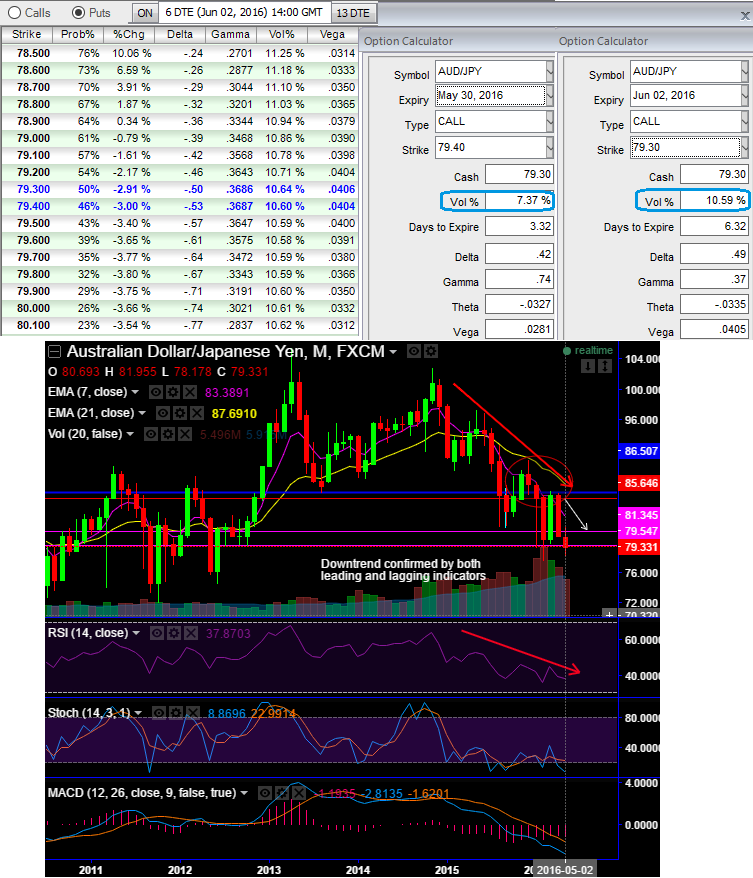
As stated in our previous article on technicals, this pair has been oscillating between 80.523 and 78.252 levels with reduced selling momentum but long term trend seems to be intact and leading and lagging indicators still favouring bears on monthly charts.
While IVs of ATM contracts of 1w and 1m tenors are progressively increasing and this has been justified by historical volatilities in spot FX fluctuations (see big real body candles on monthly technical charts).
The current ATM IVs of are flashing at 7.37% and 10.59% for 1w tenor.
Traders tend to view the put ratio back spread as a bear strategy, because it employs puts. But, longs on backspread actually needs volatility. The implied volatility of 1w ATM contract is at 10.59% and it is quite higher side when long term trend is bearish and spikes in previous rallies for short term which is good sign for option writers.
Traders tend to view the put ratio back spread as a bear strategy, because it employs puts. However, it is actually a volatility strategy.
Options with a higher IV cost more. This is intuitive due to the higher likelihood of the market 'swinging' in your favour. If IV increases and you are holding an option, this is good. You should also note short-dated options are less sensitive to IV, while long-dated are more sensitive.
While on 6 Days To Expiry (6DTE) gamma of OTM put strikes have been steadily moving with stagnant IVs, which means sensitivity in the rate of change in delta would also be considerable. So, one can utilize such productive instruments to optimize the functionality of longs in the strategy.
As we expect the underlying currency exchange rate of AUDJPY to make a larger move on the downside. As shown in the figure purchase 1M 2 lots of At-The-Money -0.52 delta puts and sell 1W one lot of (1%) In-The-Money put option.
So far we all know that the position uses long and short puts in the ratio, such as 2:1 or 3:2 and so on to maximize returns depending upon risk appetite and returns expectations.
Based on volatility and time decay, the strategy is a "price neutral" approach to options, and one that makes a lot of sense.







