


 UBS Predicts Potential Fed Rate Cut Amid Strong US Economic Data
  Goldman Sachs Sees Fed Holding Interest Rates Steady Until 2027
  Taiwan Central Bank Likely to Keep Interest Rates Unchanged Through 2027
  Japan Signals Preference for Low Interest Rates as BOJ Policy Debate Intensifies
  Geopolitical Shocks That Could Reshape Financial Markets in 2025
  BOJ Rate Hike Expected to Boost Yen, Impact USD/JPY and Nikkei
  Gold Prices Slide as Rate Cut Prospects Diminish; Copper Gains on China Stimulus Hopes
  UBS Projects Mixed Market Outlook for 2025 Amid Trump Policy Uncertainty
  U.S. Stocks vs. Bonds: Are Diverging Valuations Signaling a Shift?
  US Gas Market Poised for Supercycle: Bernstein Analysts
  Lithium Market Poised for Recovery Amid Supply Cuts and Rising Demand
  Indonesia Passes New Central Bank Law, Raising Investor Concerns Over Policy Independence
  U.S. Banks Report Strong Q4 Profits Amid Investment Banking Surge


Japanese machinery orders on monthly basis ha dramatically spiked over 4%, a massive jump comparatively with previous -3.3%. This signifies the change in the total value of new private-sector purchase orders placed with manufacturers for machines, excluding ships and utilities, which in turn, it reflect in industrial output.
It's a leading indicator of the growing purchase orders signal that manufacturers would considerably increase activity as they work to fill the orders.
Short-term Outlook: The yen continues to underperform most currencies, which is unsurprising given the risk-seeking mood since the US election. NZDJPY’s next upside target is 83.786, which marked a peak in late 2015. The yen’s identity as a risk-averse currency means it has performed badly, even while the recent run of data suggests improving momentum into the end of the year. That improvement should be reflected in another modest lift in the Tankan survey on Wed.
Medium-term outlook: A reluctant to cut BOJ leaves the cross vulnerable to a pullback below 80. With the inflation pulse moving higher helped by the combined sharp rise in commodity prices and the plunge in the yen, there are more reasons for the BoJ to observe from the sidelines.
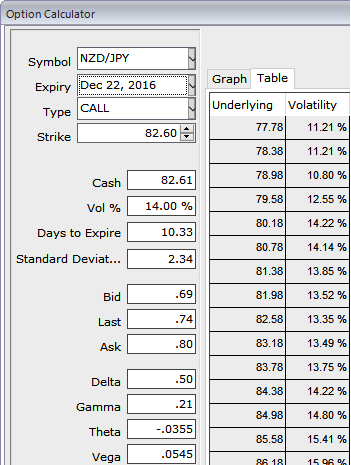
Please be noted that the 10D ATM implied volatilities of NZDJPY is spiking above 14% ahead of BoJ’s monetary policy that is scheduled for next week and followed by Kiwis growth numbers.
As a result, hedgers of this pair are so keen on the turbulence surrounded by this pair, in such circumstances, vega calls are the most conducive for the upside risks, please also be informed that the Vega is the sensitivity of an option’s value to a change in volatility. It is usually expressed as the change in premium value per 1% change in implied volatility.
For an instance, as you could see the sensitivity tool for 2w NZDJPY ATM call, the Vega of a long (buy) option position is JPY 674 and if IV increases or decreases by 1%, the option’s premium would increase or decrease by JPY 674, respectively.







