


 Gold's Tug-of-War: Geopolitical De-escalation Fights Falling Yields as Markets Eye US CPI
  Philippines Current Account Deficit Seen at $19.1 Billion in 2026
  Dogecoin Price Rises as Bitwise Plans DOGE ETF Closure
  Fed’s Hammack Says More Data Needed Before Next Rate Move
  Nasdaq Faces Pullback to 26,225 Despite Bullish Outlook, UBS Says
  Navigating the Crypto Pulse: Weekly Market Resilience and Institutional Inflows
  Deutsche Bank CEO Urges Faster German Economic Reforms
  Bank of America Predicts Yen Rebound as USD/JPY Faces Risks
  NEAR Price Surges 11% as Trading Volume Doubles
  Hyperliquid (HYPE) Price Analysis: Can Bulls Push Above $88?
  XRP Price Holds $1.35 Support as Bears Target $1.25
  Cardano Hits Five-Year Transaction Record as ADA Price Falls
  Fed Unveils Stablecoin Rules Under GENIUS Act
  Morgan Stanley Predicts $10 Trillion RWA Market by 2030
  Ethereum Foundation-Linked Wallets Move $11.13M in ETH to Kraken


 Add as a preferred source on Google
European Central Bank upgrades GDP outlook and removes easing bias.
The first round of French assembly election strengthens Macron’s hand.
Last week it was the ECB and the UK elections, this week it is the Fed, BoE, and BoJ: major events for the FX market are on the agenda. An FX analyst writing the commentary at the start of the week would find it easy to fuel hope (or fear, depending on one’s perspective) of dramatic exchange rate moves in one or the other direction.
The euro avoided the worst scenario after the French presidential election when anti-EU risk sentiment threatened to force the currency below its two-year range.
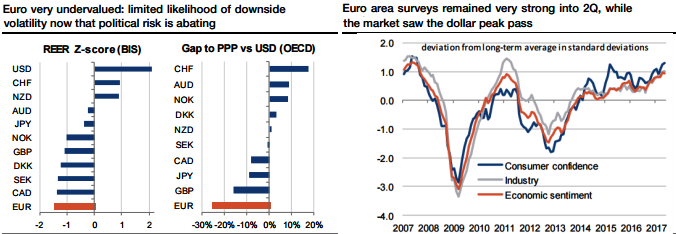
Now, the bearish case is definitely losing ground, and thanks to the structural surplus of the euro area and lasting undervaluation of the single currency (PPP and REER – refer above graph), EURUSD should remain above parity.
Now that the market perceives that political risk has massively receded, its focus will return to the ECB. The monetary divergence should morph, as the Fed has already started to tighten and the ECB could be prompted to smooth its forward guidance and taper QE as soon as reflation signs are confirmed. Meanwhile, the dollar is losing ground.
The EURUSD range of 1.05 - 1.16 corresponded to the period of ECB asset purchases, which are keeping the euro under pressure. Our economists expect a compromise in September, seeing an extended programme but at a reduced monthly pace starting in 4Q’17.
With the reversal of QE, tapering is probably one of the main factors that could lift the euro. As economic sentiment is becoming much brighter (refer above graph), the new nature of the monetary divergence could be among the factors triggering a volatile euro bullish wave.
Since January 2015 EURUSD has not traded above 1,15 or below 1.05 on a sustainable basis, since the Brexit referendum EURGBP has not eased below 0.8350, nor has it traded above 0.8770 since November – with the exception of short, erratic spikes. And this phenomenon is by no means restricted to G10 exchange rates.







