


 Stock Futures Dip as Investors Await Key Payrolls Data
  Oil Prices Dip Slightly Amid Focus on Russian Sanctions and U.S. Inflation Data
  Navigating the Crypto Pulse: Weekly Market Resilience and Institutional Inflows
  U.S. Banks Report Strong Q4 Profits Amid Investment Banking Surge
  Deutsche Bank CEO Urges Faster German Economic Reforms
  Fed Unveils Stablecoin Rules Under GENIUS Act
  Dogecoin Price Rises as Bitwise Plans DOGE ETF Closure
  RBI Uses $10 Billion Currency Swaps to Drain Excess Rupee Liquidity
  Trump’s "Shock and Awe" Agenda: Executive Orders from Day One
  NEAR Price Surges 11% as Trading Volume Doubles
  Bank of America Predicts Yen Rebound as USD/JPY Faces Risks
  Urban studies: Doing research when every city is different
  Lithium Market Poised for Recovery Amid Supply Cuts and Rising Demand
  DeFi Development Adds 22,070 SOL to Solana Treasury
  U.S. Stocks vs. Bonds: Are Diverging Valuations Signaling a Shift?


 Add as a preferred source on Google
We have received two surprises to reduce downside risks to USDJPY.
One is from politics and the other is from the macro side:
With respect to politics, we had expected that FX and trade issues would have been discussed at the U.S.–Japan summit held on February 10-11, given the series of fierce attacks on Japan by President Trump before the meeting. Yet, these issues were not discussed while the communique confirmed the two nations are firm allies and the Senkaku islands fall within the scope of Article 5 of the U.S.-Japan Security Treaty. The summit was more than perfect for Japan.
On the macro side, with the chorus of hawkish commentary by the Fed officials, the market has priced in a March hike immediately. Given that, widening U.S.-Japan yield spreads have brought USDJPY higher and the pair is now reaching the upper end of its trading range since mid-January.
We now expect the Fed to deliver three hikes in this year (Mar, Jun, and Sep vs. May and Sep previously).
Driving forces for bullish/bearish scenarios:
USDJPY to 125 if 1) Strong US growth leads more aggressive Fed hikes, 2) Japanese fiscal policy becomes more expansionary, resulting in higher Japan’s inflation expectations.
USDJPY to 100 if 1) The global investors’ risk aversion heightens significantly, 2) Weak US economy dampens hopes for Fed hikes, 3) The U.S. administration talks down USDJPY aggressively.
Potential triggering events:
Econ. Min. Seko meets Ross (Mar 16)
BoJ meeting (Mar 16)
G-20 (Mar 17-18)
USTR report on trade barriers (end-March).
Hedging Framework:
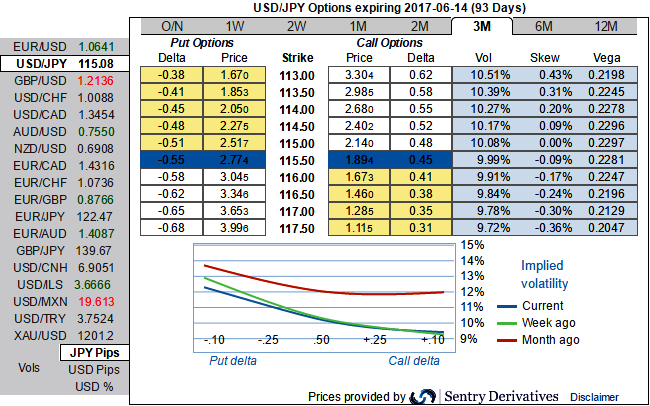
The positively skewed IVs of 3m tenors are indicating the hedgers’ interest in OTM put strikes. With bearish-neutral risk reversal in this tenor, we wouldn't be surprised even if the underlying spot FX evidences the interim spikes ahead of above mentioned Fed hiking cycle, but the below option strategy to optimally arrest any abrupt slumps towards 112.169 and 111.450 levels sooner or later.
Hence, we deploy ITM puts with longer tenors in our option strategy as the delta risk reversals favor bearish targets, hence in order to keep the risks on either side on the check we reckon diagonal debit put spreads are best suitable as the IVs and premiums are reasonable considering daily swings on technical charts.
So, here goes the strategy, Diagonal Debit Put Spread = Go long 3m (1%) ITM -0.49 delta Put + Short 1m (1%) OTM Put with lower Strike Price with net delta should be at around -0.40.
For a net debit, bear put spread reduces the cost of trade by the premium collected (on the shorts of OTM put) and keeps option trader to participate in downward moves and any upswings in abrupt.







