


 Goldman Sachs: US Dollar Likely to Stay Strong Despite Oil Price Retreat
  Goldman Predicts 50% Odds of 10% U.S. Tariff on Copper by Q1 Close
  European Stocks Rally on Chinese Growth and Mining Merger Speculation
  Gold Prices Fall Amid Rate Jitters; Copper Steady as China Stimulus Eyed
  Mexico's Undervalued Equity Market Offers Long-Term Investment Potential
  China’s AI Manufacturing Boom Masks Weak Consumer Economy, Citi Says
  Geopolitical Shocks That Could Reshape Financial Markets in 2025
  Urban studies: Doing research when every city is different
  Bank of America Posts Strong Q4 2024 Results, Shares Rise
  Gold Prices Slide as Rate Cut Prospects Diminish; Copper Gains on China Stimulus Hopes
  SpaceX Stock Gets $175 Target as Analysts See Massive Growth Ahead
  Trump’s Iran Strategy: What Has Been Achieved After Three Months of Conflict?


As widely trailed, today saw Prime Minister Theresa May announce the activation of Article 50 of the Treaty of the European Union, beginning the process of the UK’s departure from the EU. The letter, delivered to the office of EU Council President Tusk, set out some key aspirations for the UK’s terms of departure, and the future relationship with the EU.
Relative to Theresa May’s speech of 17 January – an exposé of the UK’s broad negotiating objectives – the main sources of difference were in tone, rather than content. Key aims around taking the UK out of the jurisdiction of the European Court of Justice, a departure from the EU single market – moving instead towards a “deep and special” trade agreement with the EU that includes financial services – and maintaining the common travel area with Ireland were repeated either in PM May’s statement to the House of Commons, or in the letter to Tusk.
Also confirmed was the UK’s intention to discuss the terms of departure alongside the future deal, aiming to reach agreement on the future relationship by the two-year expiry of the Article 50 process. May’s letter also speaks of implementation periods to avoid cliff-edges as the UK’s current EU membership expires, with “minimizing disruption” seen as an explicit aim.
Overall, today’s announced brought few surprises and saw a little lasting market reaction. The UK’s aspiration to discuss the exit terms in parallel with the new agreement has been communicated in the past, but may be at variance with the EU’s preference to take a sequential approach that deals with exit-related issues before discussing a future relationship.
The sterling was off 0.23% at $1.2418 at 09:00 ET after an intraday low of $1.2378. Sterling had briefly edged higher hitting an intraday maximum of $1.2475 before falling back again.
The British unit was up 0.30% at €1.1548 against the single currency. The euro was off 0.52% at $1.0757.
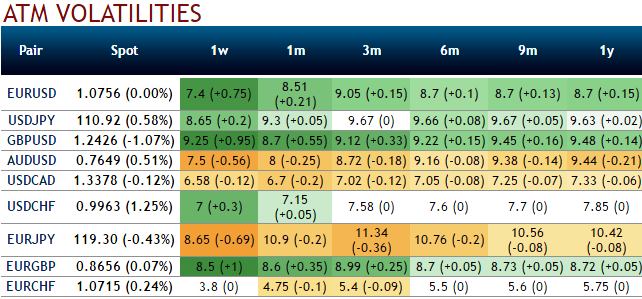
Buy GBPUSD 3m1m risk reversal strikes 1.26/1.21: we buy 3m risk reversals again that favors bearish sentiments since the GBPUSD’s implied volatility is perceived to be rising among the major currency counterparts (3m ATM contracts spiking above 9.12% in recent times.
While the 3m-1y delta risk reversal indicates hedgers have been ready to pay high premiums on OTM puts in longer time horizon.
So relying on the OTC indications, one can execute the option strategy on hedging grounds as stated below:
It is advisable to construct option strips strategy so as to mitigate the risks associated with this pair. To execute this strategy, go long in 2 lots of 3m ATM -0.49 delta puts and simultaneously, short 1 lot of ATM +0.52 delta calls of 1m tenor.







