


 FxWirePro: GBP/AUD steadies around 0.9145 ,retains bid tone
  Lithium Market Poised for Recovery Amid Supply Cuts and Rising Demand
  NZD/JPY Loses Its Shine: Kiwi Cracks Under Pressure as Bears Target 91.80
  U.S. Stocks vs. Bonds: Are Diverging Valuations Signaling a Shift?
  UBS Projects Mixed Market Outlook for 2025 Amid Trump Policy Uncertainty
  US Futures Rise as Investors Eye Earnings, Inflation Data, and Wildfire Impacts
  Gold Prices Fall Amid Rate Jitters; Copper Steady as China Stimulus Eyed
  Global Markets React to Strong U.S. Jobs Data and Rising Yields
  FxWirePro: GBP/AUD runs out of steam but maintains bullish outlook
  Pound-Yen Pullback: GBP/JPY Slips Below Key EMAs as Sterling Weakness Fuels Bearish Bet on 210
  China's Refining Industry Faces Major Shakeup Amid Challenges
  China’s Growth Faces Structural Challenges Amid Doubts Over Data
  Pound-Yen Pullback: GBP/JPY Slips Below Key EMAs as Sterling Weakness Fuels Bearish Bet on 210
  Moody's Upgrades Argentina's Credit Rating Amid Economic Reforms
  US Gas Market Poised for Supercycle: Bernstein Analysts
  FxWirePro- Major Pair levels and bias summary
  FxWirePro: GBP/NZD stuck in range but outlook is bullish


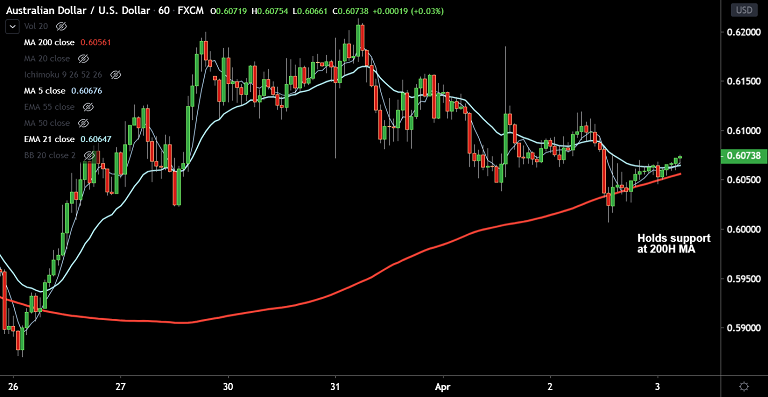
AUD/USD chart - Trading View
AUD/USD was trading 0.22% higher on the day at 0.6071 at around 05:00 GMT, bias neutral.
The Aussie dollar fails to benefit from above-forecast Aussie retail sales data and a rebound in the Chinese Caixin Services PMI.
As the coronavirus numbers continue to rise globally and governments scramble to contain the outbreak, volatility to rule markets.
Doji formation on Thursday's candle suggests indecision among traders. Technical indicators do not provide a clear directional bias.
Risks are skewed towards the downside. Stiff resistance is seen at 0.61 (nearly converged 5 and 20 DMAs).
Price action is currently extending sideways along 200H MA support (currently at 0.6056). Break below will drag the pair lower.
Focus now on US Non-Farm Payrolls March data for impetus. DXY is holding onto previous session's gains.
Analysts expect NFP to lose 100,000 in March, first decrease since September 2010. Unemployment (U-3) is expected to rise to rise to 3.8% from 3.5%.
Support levels - 0.6056 (200H MA), 0.6013 (Tenkan Sen)
Resistance levels - 0.61 (nearly converged 5 and 20 DMA), 0.6148 (21-EMA)







