


 Bitcoin ETFs Lose $681 Million, Ending Three-Week Inflow Streak
  Fed’s Logan Signals 50 Basis Points More in Rate Hikes
  Bitcoin Price Faces Volatility Ahead of US CPI and Fed Speech
  Navigating the Crypto Pulse: Weekly Market Resilience and Institutional Inflows
  BOJ Signals Faster Rate Hikes as Inflation Risks Grow
  RBI Rate Hike Bets Surge as Inflation Rises
  Bank of America Predicts Yen Rebound as USD/JPY Faces Risks
  Ethereum Foundation-Linked Wallets Move $11.13M in ETH to Kraken
  RBA Hikes Interest Rate to 4.60% as Inflation Risks Rise
  Dogecoin Price Rises as Bitwise Plans DOGE ETF Closure
  Evernorth Nasdaq Listing Nears as XRP Price Falls
  Fed’s Hammack Says Bond Yield Surge Is Not Driven by Inflation Fears
  RBA Set for September Rate Hike as Inflation Stays High


 Add as a preferred source on Google
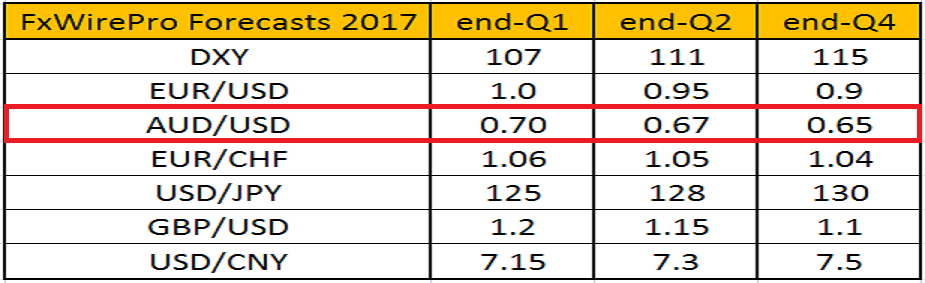
In 2016 the Australian dollar (AUD) has benefited from the recovery in commodity prices, but lost grounds at the end of the year to post U.S. Presidential election rally in U.S. Dollar. We expect this to continue even in 2017 following the Federal Reserve’s optimism on three interest rate hikes and President Donald Trump’s fiscal policies.
Thereby, we foresee that the AUD/USD to hit lowest since March 2009 by the end of the fourth quarter and trade at around 0.65.
However, the fundamentals supporting Australian dollar are favourable in 2017, keeping economic growth well above 2.5 percent mark. Also, recovery in commodity prices including energy post-OPEC deal will lend further support to the growth trajectory. Interestingly, the Australian economy will remain sensitive to the Chinese grounds as it is the largest export markets for the Aussies, which accounts 32 percent of total exports.
The easier monetary policy has helped to bolster country’s demand, as the Reserve Bank of Australia reacted to sub-target inflation by cutting the official rate by 50 basis points during the last year to 1.50 percent. Additionally, the RBA’s policy stance in 2017 will completely depend on the developments in consumer inflation and in the event that the Australian dollar appreciates.
Moreover, it is worth noting that the heavy sell-off in Australian dollar (AUD) is mainly because of Donald Trump’s fiscal spending appeal, which is expected to be financed from government borrowing and not because of growth in U.S. economy.
If Trump successfully implements his fiscal plan, consumer inflation will surely rise, giving the Federal Reserve wider space for an interest rate hike. Thereby, rising Fed fund rate will increase the cost of borrowing. After the Presidential election result, AUD witnessed a massive selling against U.S. dollar, sending the AUD lower by 8 percent to 0.715 in just a month’s time.







