


 EU Leaders Visit Kyiv on Fourth Anniversary of Bucha Massacre
  U.S. Trade Rep Dismisses WTO's Future Role After Failed Cameroon Summit
  Ukraine Open to Energy Ceasefire Amid Global Oil Crisis
  Bessent: Global Oil Market Well Supplied as U.S. Eyes Hormuz Navigation Control
  Trump Attends Supreme Court Hearing on Birthright Citizenship Restrictions
  U.S. Senator Pushes to Permanently Block Chinese Automakers from American Market
  FBI Labels Michigan Synagogue Attack as Hezbollah-Inspired Terrorism
  California's AI Executive Order Pushes Responsible Tech Use in State Contracts
  U.S. Army Investigates Military Helicopters Flying Near Kid Rock's Home and Anti-Trump Protests
  U.S. Senators Challenge FCC Chair Over Nexstar-Tegna Merger Approval
  U.S.-Iran War Talks Emerge Amid Ongoing Strikes and Economic Fallout
  Myanmar's Military Chief Steps Down to Pursue Presidency After Controversial Election
  Trump Signals U.S. Military Exit From Iran Within Weeks After Declaring Nuclear Mission Accomplished
  Iran Strikes Oil Tanker Near Dubai Amid U.S. Threats and Ongoing Middle East Conflict
  Trump Signs Executive Order Tightening Mail-In Voting Rules Amid Legal Backlash
  Trump Presidential Library: Miami Tower Plans Revealed with AI-Generated Vision
  Rubio Directs U.S. Diplomats to Use X and Military Psyops to Counter Foreign Propaganda


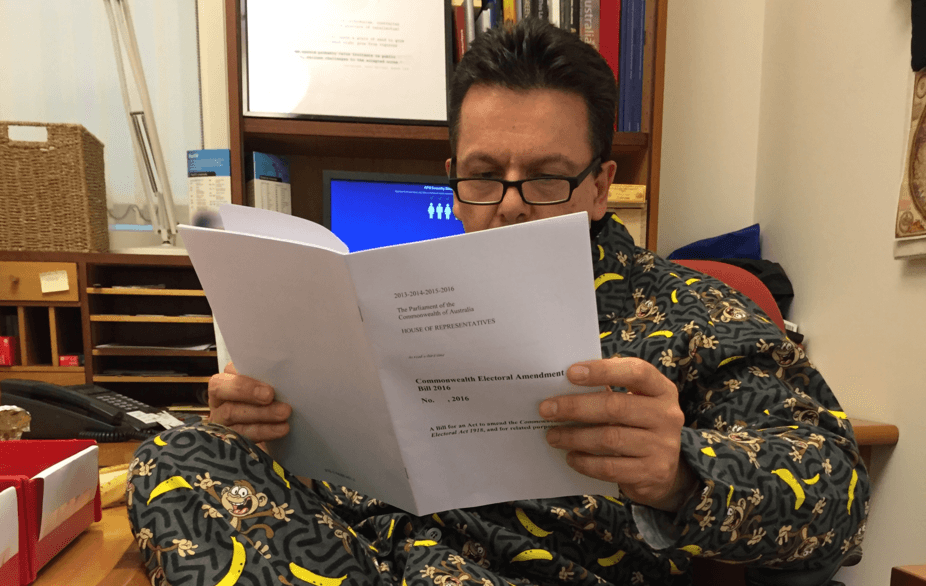
The Senate has passed the government’s comprehensive rewriting of its voting system, designed to limit the prospect of “micro” players being elected.
This paves the way for a July 2 double-dissolution election – if Malcolm Turnbull decides to pull the trigger.
The House of Representatives was set to tick off the bill on Friday afternoon, before federal parliamentarians left Canberra at the end of the autumn session.
The 39 hours of debate included a marathon sitting running all Thursday night and halfway through Friday. A Coalition-Green deal ensured the numbers for the legislation, but Labor bitterly resisted it, using filibuster tactics in the Senate throughout Thursday night. The debate was marked by angry ALP attacks on the Greens for siding with the Coalition, but also a good deal of farce and some humour.
The changes are aimed particularly at “preference whispering”, under which a candidate with an extremely small number of votes can be elected through complex preference arrangements. They follow recommendations from the joint parliamentary committee on electoral matters.
Despite the new system being loaded strongly against “micro” players, there is uncertainty about how tightly the new system will work against those with small votes in a double dissolution where the quota is only around 7.7%. Electoral experts believe Tasmanian Jacqui Lambie would probably survive at a double dissolution.
Under the deal, the government and the Greens agreed that the voting legislation would be given priority this week. Labor and crossbenchers tried to embarrass them by efforts to bring on the Australian Building and Construction Commission legislation, which is important to the government, and a bill to legalise same-sex marriage – a key issue for the Greens.
While the government insists no decision has been taken to have a July 2 double dissolution, both sides of politics believe it is likely. It would require the budget being brought forward to May 3, to get supply through by the time the election would have to be called, which is May 11.
The Senate has passed a motion removing the [resident’s discretion to recall it early if the budget is brought forward to May 3. This means that supply for a double dissolution could not be passed through the upper house until May 10.
The Senate did not start seriously considering the plethora of amendments to the legislation until well into the early hours of Friday morning, with votes being continually forced as it ploughed through them.
Special Minister of State Mathias Cormann, who had carriage of the bill, kept up a stream of tweeting as the hours dragged on.
He told the Senate: “if you still want to be here on Easter Friday…that’s fine”.
Labor constantly said the government was pushing the changes through to prepare for a double dissolution. Cormann said “I honestly don’t know” about the timing or form of the election.
Labor’s ferocious attack on the legislation, which it said had been rushed and would make the Senate a closed shop by excluding the new players, was undermined on Thursday when its former spokesman on electoral affairs, Gary Gray, said in a parliamentary speech he was “sad” that his colleagues were opposing the change. Gray and some other Labor MPs strongly backed reforming the Senate voting system but were overruled in the party by those who believed the change would work to the Coalition’s long-term benefit.
Labor’s senator Stephen Conroy told the ABC that “the Greens have betrayed their basic principles”, because their platform said they wanted to see diversity in parliaments.
“This is a system designed … to get rid of all the crossbench senators. And what you’ll see is only representatives from Labor, the Coalition, the Greens and Nick Xenophon who’s a South Australian phenomenon.”
Greens leader Richard Di Natale said: “we have made history this morning. We have taken power away from back room operators and given it to voters.”


Michelle Grattan does not work for, consult, own shares in or receive funding from any company or organization that would benefit from this article, and has disclosed no relevant affiliations beyond the academic appointment above.
Michelle Grattan, Professorial Fellow, University of Canberra
This article was originally published on The Conversation. Read the original article.







